Coast FIRE in your 20s: why early money does the heavy lifting
By Gourav Boruah · October 25, 2026 · 8 min read

Coast FIRE in your 20s is the easiest version of the plan, because time does most of the work for you. At 7% growth and 3% inflation, every $1 you invest at 25 grows to about $4.95 in today’s money by 67. So someone who is 25, has $10,000 invested and saves $800 a month could stop saving for retirement at 39, and still reach their full pot by 67.
Want your own number first? Use the Coast FIRE calculator. It takes a minute and nothing is sent anywhere.
If “Coast FIRE” is new to you, start with what Coast FIRE is. In short: it is the point where the money you already have can grow into your full retirement pot on its own, so you can stop saving for retirement and only earn enough to pay for today.
Why money in your 20s does the heavy lifting
Money grows on top of its own growth. The longer it sits, the bigger that effect gets. In the calculator’s default settings, money grows about 3.88% a year faster than prices. That is “real growth”: growth after inflation. Why 7% growth is not really 7% explains it in more detail.
Here is what $1,000 invested today is worth at 67, in today’s money:
| Invested at age | Years to grow | Worth at 67 |
|---|---|---|
| 25 | 42 | $4,953.99 |
| 30 | 37 | $4,094.70 |
| 35 | 32 | $3,384.46 |
| 40 | 27 | $2,797.42 |
The same $1,000 does almost twice as much work at 25 as it does at 40. That is the whole idea behind this article. A dollar saved in your 20s is not just a dollar. It is closer to five dollars of future retirement money.
A worked example: Priya at 25
Meet Priya. She is 25, has $10,000 invested and puts in $800 a month, including anything her employer adds.
She thinks she will want to spend about $40,000 a year in retirement, in today’s money. She plans to retire at 67 and expects a state pension (or Social Security) of about $18,000 a year from then.
She uses the calculator’s defaults: 7% growth, 3% inflation and a 4% withdrawal rate. The withdrawal rate is the share of the pot you take out each year in retirement.
Step 1: The pot she needs at 67. ($40,000 − $18,000) ÷ 0.04 = $550,000.
Step 2: Real growth. (1 + 0.07) ÷ (1 + 0.03) − 1 = 3.88% a year.
Step 3: How much $1 grows to in 42 years. 1.0388 to the power of 42 = about 4.95.
Step 4: Her Coast FIRE number today. $550,000 ÷ 4.95 = about $111,000 (the calculator’s exact figure is $111,021.60).
With $10,000, she is only 9.0% of the way there. That sounds like a long road. But she adds $9,600 a year, and her money grows at the same time. She catches up at 39, with $191,252.66 invested. After that she can stop saving for retirement completely, and growth alone takes her to about $555,790.30 by 67.
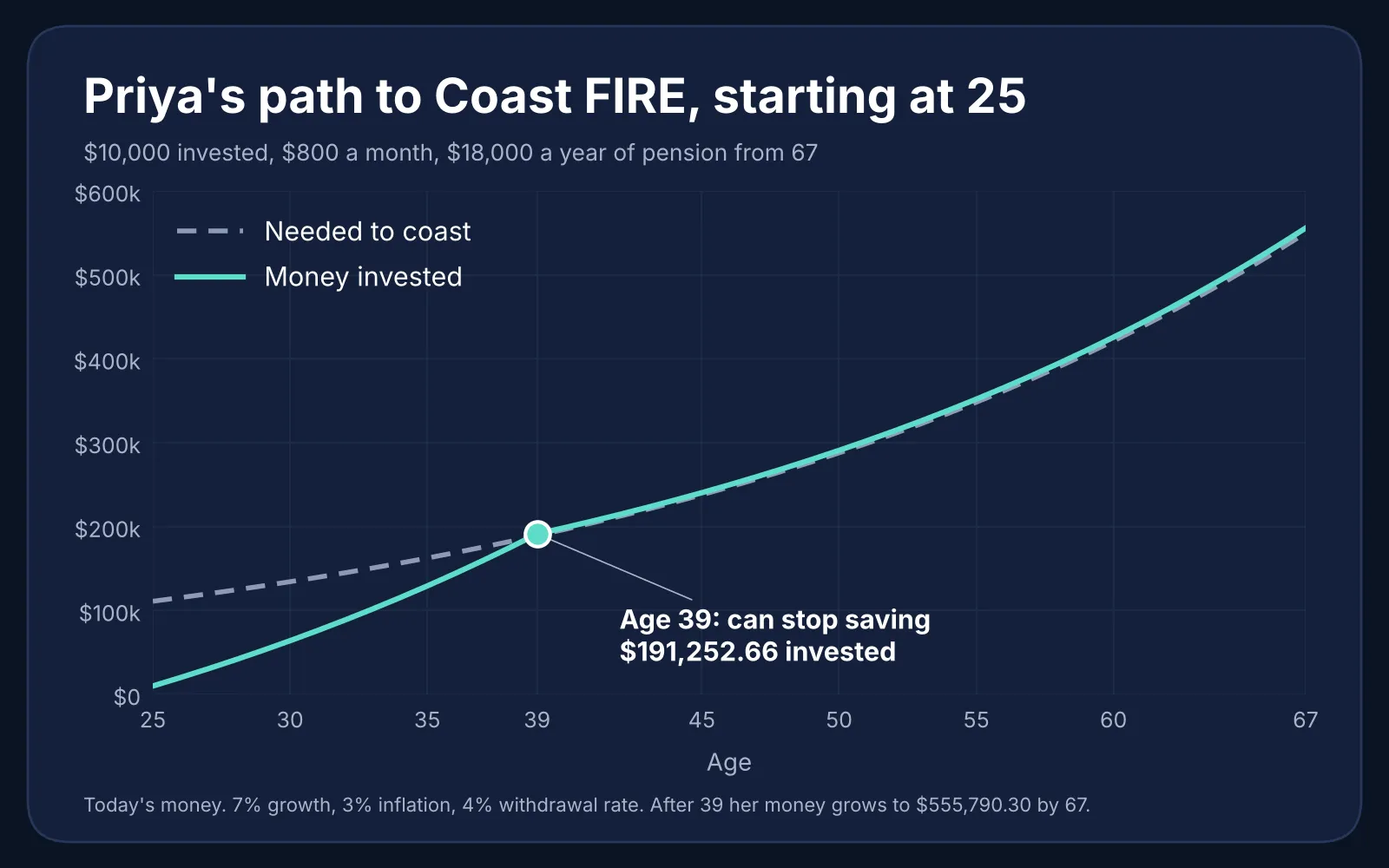
Her money invested (teal) meets the amount needed to coast (dashed) at 39. From then on, growth does the rest.
Who really did the work: Priya or her money?
Let us add up what Priya actually put in. She started with $10,000 and saved $9,600 a year for 14 years: $144,400 in total. Her pot at 67 is $555,790.30. So about 74% of her retirement money comes from growth, not from her own saving.
Now meet Sam. He has the same $10,000 and saves the same $800 a month, but he only starts at 35. He has to keep saving for 26 years, until 61. He puts in $259,600 in total, and growth makes up only about 54% of his pot.
Sam pays in over $115,000 more, and stops saving 22 years later. Nothing about Sam is lazy or wrong. He simply gave his money less time.
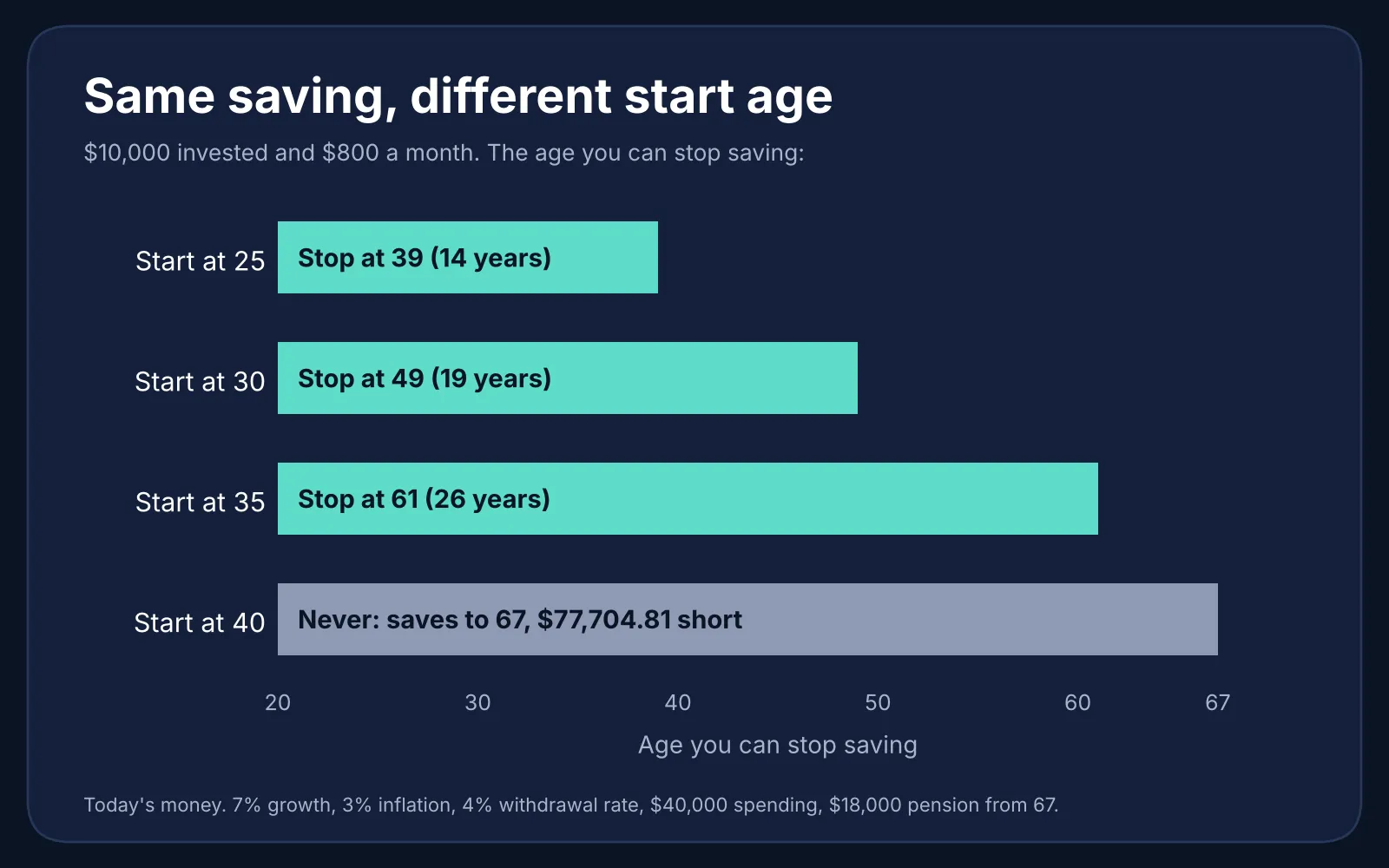
Same savings, different start age. Each five-year delay pushes the stop-saving age back by ten years or more.
If you are reading this at 35 or 40, this is not a reason to give up. It is a reason to look at the levers in Coast FIRE at 40 or 45. For the amount needed at each age, see Coast FIRE number by age.
How much you save each month still matters
Starting early is the big lever. How much you save is the second one. Here is Priya at 25 with different monthly amounts. Everything else stays the same.
| Saving each month | She can stop saving at | Years of saving |
|---|---|---|
| $500 | 53 | 28 |
| $600 | 46 | 21 |
| $700 | 42 | 17 |
| $800 | 39 | 14 |
| $1,000 | 36 | 11 |
Going from $500 to $800 a month cuts her saving years in half. In your 20s, a small raise in your monthly saving can buy back whole decades later on.

Test your plan with less friendly numbers
A plan that only works with perfect numbers is not much of a plan. Here is what happens to Priya’s stop-saving age when one thing goes against her:
- Growth is 6% instead of 7%. Her Coast FIRE number today rises to $164,694.76, and she stops saving at 48 instead of 39. Saving $1,000 a month would bring that back to 42.
- She uses a 3.5% withdrawal rate instead of 4%. The pot she needs grows to $628,571.43, and she stops at 42. The 4% rule explained shows why some people prefer 3.5%.
- She ends up wanting $45,000 a year, not $40,000. The pot she needs grows to $675,000, and she stops at 44.
- She gets no pension at all. The pot she needs doubles to $1,000,000, and she has to save until 65. This is why it pays to check what your pension will really be. Coast FIRE with a pension shows how to count one safely.
Even in the tougher versions, she still finishes saving years before 67. That is the real gift of starting early: room for things to go wrong.
The honest catches
Coast FIRE in your 20s has some real weak spots, and it is better to know them now.
Your life will change. At 25, you are guessing what you will spend at 67. A partner, children, a move or a new career can all change that number. Treat your figure as a first draft and run the calculator again every year or so.
Lifestyle creep is the quiet risk. Coast FIRE only stays reached if your future spending stays near your plan. If your income doubles and your planned retirement spending doubles with it, your Coast number jumps too, often by more than double once a pension is counted.
Some things may need to come first. Expensive debt and having no emergency money can undo a good plan. Many people deal with those before investing hard, but the right order depends on your own situation.
Growth is never guaranteed. Markets can fall for years. The figures here assume steady average growth, which real markets never give. Testing a lower rate, as above, is a sensible guard.
Reaching Coast FIRE does not mean you stop working. It means you stop saving for retirement. You still need to earn enough to pay for today. If you want to cut back your hours instead, the Barista FIRE calculator shows how that works.
Coast FIRE in your 20s: questions people often ask
How much do I need for Coast FIRE at 25? It depends on your spending, pension and retirement age. For Priya, wanting $40,000 a year with an $18,000 pension at 67, it is $111,021.60. Most people in their mid-20s are nowhere near that yet, and that is normal. What matters is when your saving gets you there.
Is Coast FIRE by 30 realistic? For some people, yes, but it usually takes a high saving rate. In Priya’s plan, even $1,000 a month gets her there at 36. A higher income, a lower spending goal or a bigger starting pot would bring it closer.
Does my employer’s contribution count? Yes. Anything that goes into your retirement accounts each month counts as monthly saving in the calculator, whoever pays it in. Rules and limits for workplace and personal accounts differ by country and change often, so check your government’s official pages.
Should I put everything into investing in my 20s? This article cannot tell you how to invest. It can show that early money goes a long way. But a plan you can stick with, with some money for today and for emergencies, often beats a plan you give up on after two years.
We are a couple in our 20s. Does this change? The maths is the same. Add both pots, both monthly savings and both pensions. Coast FIRE for couples shows how to plan with two ages.
Five steps to take today
- Add up everything you have invested for retirement, across all accounts. Even $0 is a fine starting point.
- Work out what goes in each month, including anything your employer adds.
- Pick a rough yearly spending figure for retirement, in today’s money. Your current spending is a reasonable first guess.
- Check your expected state or work pension on your government’s or employer’s official pages.
- Open the calculator, enter your figures, then try $100 or $200 more a month and see how many years it takes off your stop-saving age.
Every setting is explained on the methodology page.
Work out your own number
In your 20s, your biggest advantage is not your income. It is time. Each dollar you invest now has decades to grow, so a few years of steady saving can do what would take twice as long later.
Find your Coast FIRE number. It works for singles and couples, includes pensions, and shows every step of the maths with your own figures.
This article is for education, not financial advice. All figures are in today’s money and do not include taxes or fees.
What is your Coast FIRE number?
Find the age you can stop saving for retirement. Free, no sign-up, and your numbers stay on your device.
Find your own Coast FIRE numberPhotos: Min An, FOTOGRAFÍA EDITORIAL on Unsplash.