The 4% rule explained, and when to use 3.5% instead
By Gourav Boruah · October 18, 2026 · 9 min read

The 4% rule says you can take 4% of your pot in your first year of retirement, then the same amount plus inflation each year after, and your money has a good chance of lasting about 30 years. So to spend $40,000 a year, you need a pot of $1,000,000. Using 3.5% instead is a safety margin: the same spending needs $1,142,857, about 14% more.
Want your own number first? Use the Coast FIRE calculator. It takes a minute and nothing is sent anywhere.
What the 4% rule actually says
The rule answers one question: how much can I take out of my investments each year without running out?
Here is how it works, in three steps:
- Year one: take out 4% of your pot. With $1,000,000, that is $40,000.
- Every year after: take out last year’s amount, raised by inflation. If prices rose 3%, you take $41,200 in year two.
- Ignore the markets. You do not take more in a good year or less in a bad one. Your spending stays steady in today’s money.
A common mix-up is to think you take 4% of whatever your pot is worth each year. That is a different method. Under the 4% rule, the 4% is only worked out once, on the day you retire.
The flip side gives you a quick way to work out your pot. Divide 1 by the withdrawal rate. At 4%, that is 25, so your pot needs to be 25 times your yearly spending. At 3.5%, it is about 28.6 times.
Where the 4% comes from
The idea comes from a 1994 paper by a financial planner, William Bengen, in the Journal of Financial Planning. He looked at US stock and bond returns going back to the 1920s. He asked: what is the highest starting withdrawal that would have lasted at least 30 years, even for someone who retired at the worst possible moment? The answer came out at about 4%.
In 1998, three professors at Trinity University tested the same idea with different stock and bond mixes and time spans. Their paper, often called the Trinity study, found that 3% to 4% held up well over 30 years for portfolios with plenty of shares in them.
So the 4% rule is not a law of nature. It is a summary of what did work in the past, in one country, over 30 years.
Is 4% still safe today?
Experts disagree, and the number moves around. Three useful reference points:
- Morningstar, a US investment research firm, publishes a yearly estimate. For 2026 it put the safe starting rate at 3.9%, up from 3.7% the year before. That is for 30 years, a 90% chance of success, and a mix of 30% to 50% shares.
- Bengen himself raised his figure to about 4.7% in a 2025 book, A Richer Retirement, after adding more types of shares to the mix. It still assumes 30 years and US market history.
- Outside the US, the picture is weaker. A 2010 study by Wade Pfau looked at 17 developed countries over more than 100 years. A 4% withdrawal would have been safe in only 4 of them.
Put simply: 4% is a fair middle-of-the-road starting point. It is not a promise. Many careful plans use something between 3.5% and 4%.
How the rate changes your pot
The withdrawal rate sits at the bottom of the main sum, so small changes make a big difference.
Pot needed = (spending − pension) ÷ withdrawal rate
For $40,000 a year with no pension:
| Withdrawal rate | Pot needed | Times your spending |
|---|---|---|
| 4.5% | $888,889 | 22.2 |
| 4% | $1,000,000 | 25 |
| 3.5% | $1,142,857 | 28.6 |
| 3% | $1,333,333 | 33.3 |
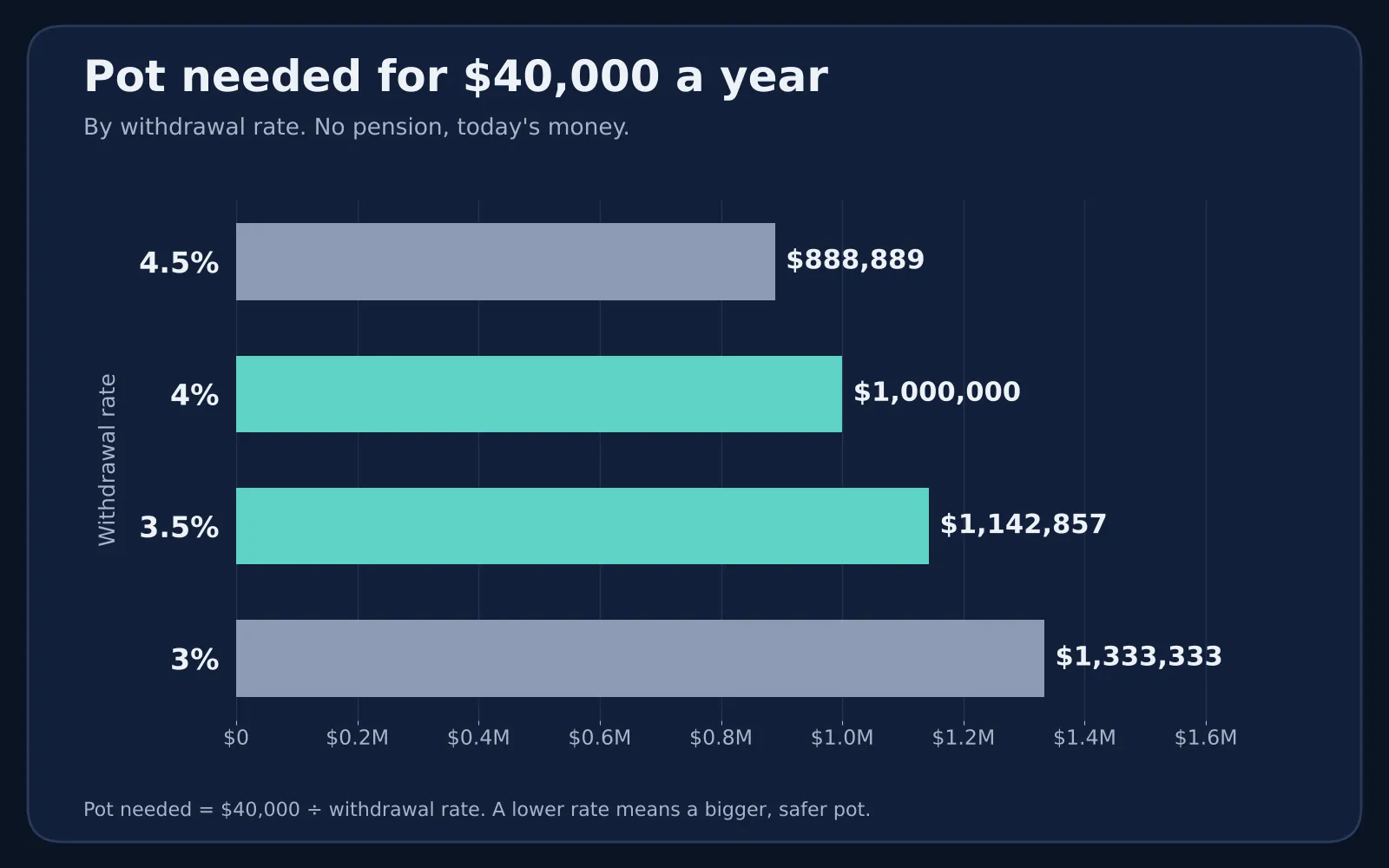
Every half a percentage point lower adds well over $100,000 to the pot. $40,000 a year, no pension, today’s money.
Your Coast FIRE number moves by exactly the same share. At 30, aiming to retire at 65, it is $263,555 at 4% and $301,205 at 3.5%. At 40, it is $385,777 at 4% and $440,888 at 3.5%. Going from 4% to 3.5% always raises the number by about 14%, whatever your age. If you want to see the full table by age, read Coast FIRE number by age.
A worked example: Aisha at 32

Meet Aisha. She is 32, has $90,000 invested and adds $1,000 a month. She wants to spend $36,000 a year from 65 in today’s money. In this example she has no pension. She is not sure whether to plan with 4% or 3.5%, so she works out both.
We use the calculator’s standard settings: 7% growth and 3% inflation.
Step 1: The pot she needs at 65. At 4%: $36,000 ÷ 0.04 = $900,000. At 3.5%: $36,000 ÷ 0.035 = $1,028,571.
Step 2: Real growth. This is growth after inflation: (1 + 0.07) ÷ (1 + 0.03) − 1 = 3.88% a year.
Step 3: How much $1 grows to in 33 years. 1.0388 to the power of 33 = 3.516. So every dollar she has today becomes about $3.52 by 65, in today’s money.
Step 4: Her Coast FIRE number today. At 4%: $900,000 ÷ 3.516 = $255,980. At 3.5%: $1,028,571 ÷ 3.516 = $292,549.
With $90,000 invested, she is 35% of the way at 4%, or 31% at 3.5%.
Here is the surprise. The 3.5% number is only 14% higher, but it pushes her stop-saving age back by seven years.
- At 4%, Aisha catches up at 53, with $579,077 invested.
- At 3.5%, she catches up at 60, with $850,515 invested.
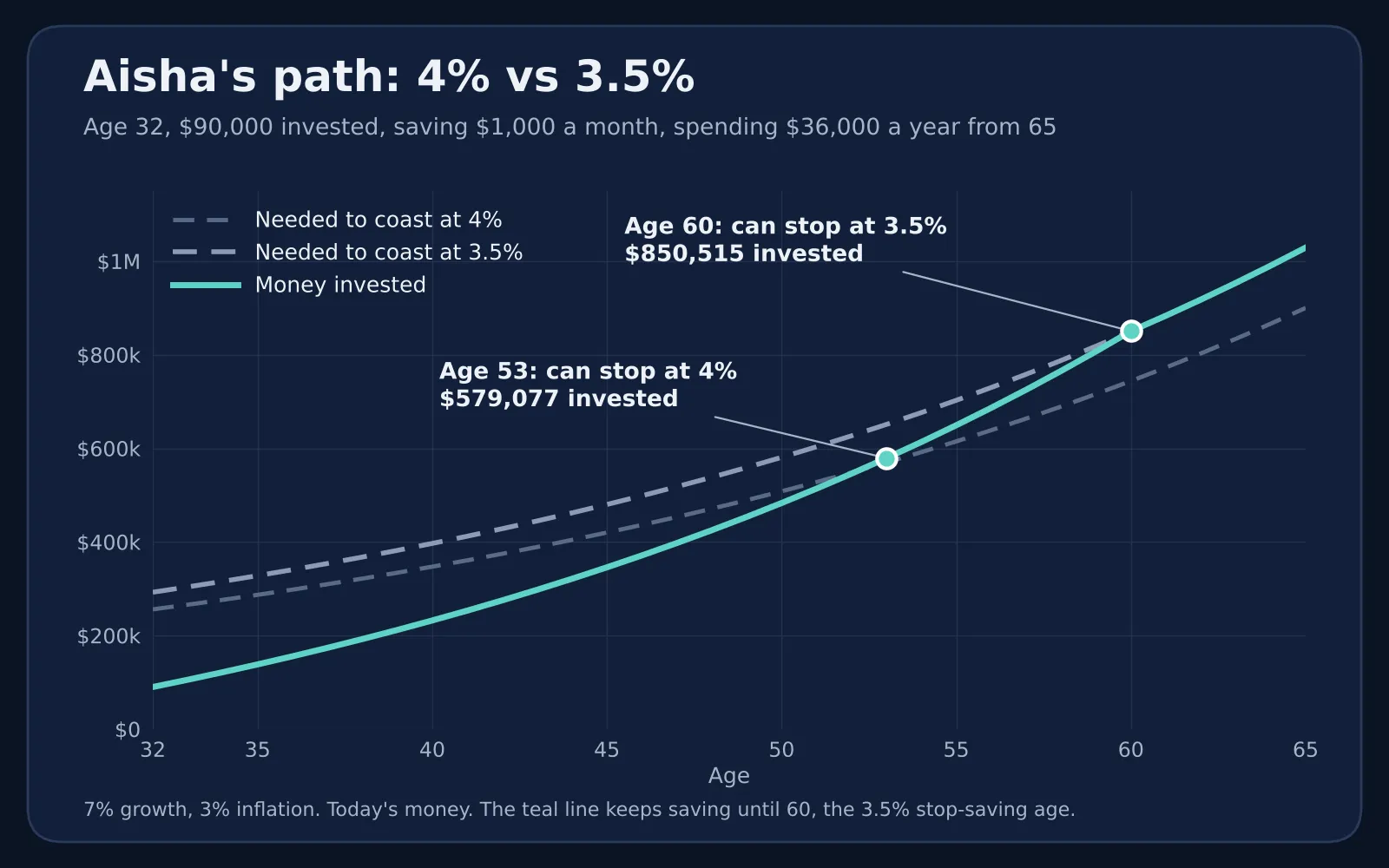
Aisha’s money invested (teal) meets the 4% line at 53 and the 3.5% line at 60. The lines are close together, so a small gap takes years to close.
Why so big a jump? Look at the chart. Her savings line and the coast lines run almost side by side in her 50s. When two lines are that close, a 14% higher target takes many extra years to reach.
The good news is that she does not have to choose between safety and an early stop. A little more saving closes the gap. At 3.5%:
| Aisha saves | She can stop saving at |
|---|---|
| $1,000 a month | 60 |
| $1,200 a month | 53 |
| $1,300 a month | 51 |
| $1,500 a month | 48 |
An extra $200 a month gives her the safer 3.5% plan and still lets her stop at 53, the same age as the 4% plan.
What a pension does to the gap
Now say Aisha expects a state pension of $12,000 a year from 65. Her investments only need to cover the other $24,000.
- At 4%, her pot falls to $600,000 and she can stop saving at 40.
- At 3.5%, her pot falls to $685,714 and she can stop saving at 43.
The gap between the two shrinks from seven years to three. The withdrawal rate only applies to the part of your spending that your pension does not cover. The bigger your pension, the less the choice of rate matters. Coast FIRE with a pension explains how to count one.
When 4% is reasonable
For Coast FIRE, the 4% rule fits better than it does for classic early retirement. Most Coast FIRE plans spend the pot from around 65, so 30 years is about right. 4% may be a fair choice if most of these are true for you:
- You plan to retire at 65 or later, so 30 years or so is enough.
- A pension will cover a good share of your spending.
- You could cut back for a year or two after a bad market.
- You will check your plan every year and adjust, rather than set it and forget it.
When to use 3.5% instead
A lower rate gives you room for a bad start, a long life or weaker markets. Think about 3.5% if any of these sound like you:
- You want to retire before 60. Your money may need to last 35 to 40 years or more. The classic studies only tested 30.
- You invest mostly outside the US. The 4% figure comes from US history, one of the strongest markets of the last century. Other countries have done worse.
- Your spending is fixed. If you could not cut back after a crash, you need more room up front.
- You have little or no pension. Your pot has to do all the work.
- You pay high fees. A 1% yearly fee comes straight out of what you can safely take.
- You would rather sleep well. Planning with 3.5% and then finding you have more than enough is a happy problem.
Some people go lower still, to 3% or 3.25%, for very long early retirements. Others plan with 4% but agree with themselves in advance to trim spending in bad years. Both are reasonable. What matters is choosing on purpose.

A simple way to decide today
- Open the calculator and enter your numbers at the standard 4%.
- Note your Coast FIRE number and your stop-saving age.
- Tap Change next to the assumptions, set the withdrawal rate to 3.5%, and note them again.
- If the two stop-saving ages are only a year or two apart, use 3.5%. The safety costs you little.
- If they are far apart, like Aisha’s, see what an extra $100 or $200 a month does at 3.5%.
- Write down which rate you chose and why, so you stick with it when markets get noisy.
If you are comparing different flavours of FIRE, the same choice applies. See Coast FIRE vs Barista FIRE vs Lean FIRE vs Fat FIRE, or try the Fat FIRE calculator.
What the 4% rule does not tell you
- It is not a guarantee. It is based on past markets. The future can be better or worse.
- It ignores taxes and fees. The $40,000 is before tax. What you can spend depends on your country and your accounts.
- It assumes steady spending. Real retirements often spend more early on and less later. That can help, but it is not built into the rule.
- It is a starting point, not an autopilot. Checking once a year and adjusting is part of making it work.
Every setting our calculator uses is listed on the methodology page.
Work out your own number
Try your plan at both 4% and 3.5%. Seeing the two side by side is the quickest way to know how much safety costs you.
Find your Coast FIRE number. It works for singles and couples, includes pensions, and shows every step of the maths with your own figures.
This article is for education, not financial advice. All figures are in today’s money and do not include taxes or fees.
What is your Coast FIRE number?
Find the age you can stop saving for retirement. Free, no sign-up, and your numbers stay on your device.
Find your own Coast FIRE numberPhotos: Diego Montalvan, Anh Tuan, Tristan Le on Unsplash.