Coast FIRE vs Barista FIRE vs Lean FIRE vs Fat FIRE: which one fits you
By Gourav Boruah · October 16, 2026 · 8 min read

The four types of FIRE answer two different questions. Lean FIRE and Fat FIRE are about how much you will spend once you stop work. Coast FIRE and Barista FIRE are about how much you still work on the way there. Coast FIRE is usually the first one you can reach, and Fat FIRE the last.
Want your own number first? Use the Coast FIRE calculator. It takes a minute and nothing is sent anywhere.
The four types in one minute
FIRE stands for Financial Independence, Retire Early. Classic FIRE means having enough invested that you never need to work again. The other names are variations on that idea.
- Coast FIRE. You have enough invested that growth alone will carry it to your full retirement pot by a normal retirement age. You stop saving for retirement, but you keep working to pay for your life today.
- Barista FIRE. You have enough invested that a part-time job can cover the rest. You leave full-time work, earn a smaller income, and take a little from your investments each year.
- Lean FIRE. You stop work completely, but on a tight budget.
- Fat FIRE. You stop work completely, on a generous budget with room for travel, help at home and surprises.
There are no official lines between these. Some people call anything under about $40,000 a year “lean” and anything over about $100,000 “fat”, but those are habits of the online FIRE community, not rules. What counts as lean in New York may be comfortable somewhere else. The numbers that matter are your own.
| Type | Do you still work? | Do you still save? | Spending level |
|---|---|---|---|
| Coast FIRE | Yes, enough to pay today’s bills | No, not for retirement | Your normal level |
| Barista FIRE | Yes, part-time | No | Your normal level |
| Lean FIRE | No | No | Tight |
| Fat FIRE | No | No | Generous |
One person, four numbers
The easiest way to see the difference is to run all four for the same person.
Meet Maya. Maya is 30, has $100,000 invested and adds $1,500 a month. She expects to spend $45,000 a year in today’s money. She has no pension to count on in this example. We use the calculator’s standard settings: 7% growth, 3% inflation, and a 4% withdrawal rate. The withdrawal rate is the share of your pot you take out each year.
First, the growth rate after inflation, which every type uses:
(1 + 0.07) ÷ (1 + 0.03) − 1 = 3.88% a year
Each FIRE number then uses the same simple rule: the yearly amount your investments must pay, divided by the withdrawal rate.
Full FIRE at $45,000 a year: $45,000 ÷ 0.04 = $1,125,000
Lean FIRE at $30,000 a year: $30,000 ÷ 0.04 = $750,000
Fat FIRE at $90,000 a year (double her normal spending): $90,000 ÷ 0.04 = $2,250,000
Barista FIRE, with a part-time job paying $20,000 a year: ($45,000 − $20,000) ÷ 0.04 = $625,000
Coast FIRE is a little different, because Maya keeps working until 65 and lets time do the rest. She needs an amount today that grows into $1,125,000 by 65. That is 35 years of growth:
$1,125,000 ÷ 1.0388^35 = $1,125,000 ÷ 3.794 = $296,499
So Maya’s Coast FIRE number today is $296,499. With $100,000 invested, she is 34% of the way there.
When Maya reaches each one
Maya’s balance grows each year at 3.88% after inflation, plus her $18,000 a year of saving. The calculator steps forward one year at a time and finds the first age at which her balance reaches each number.
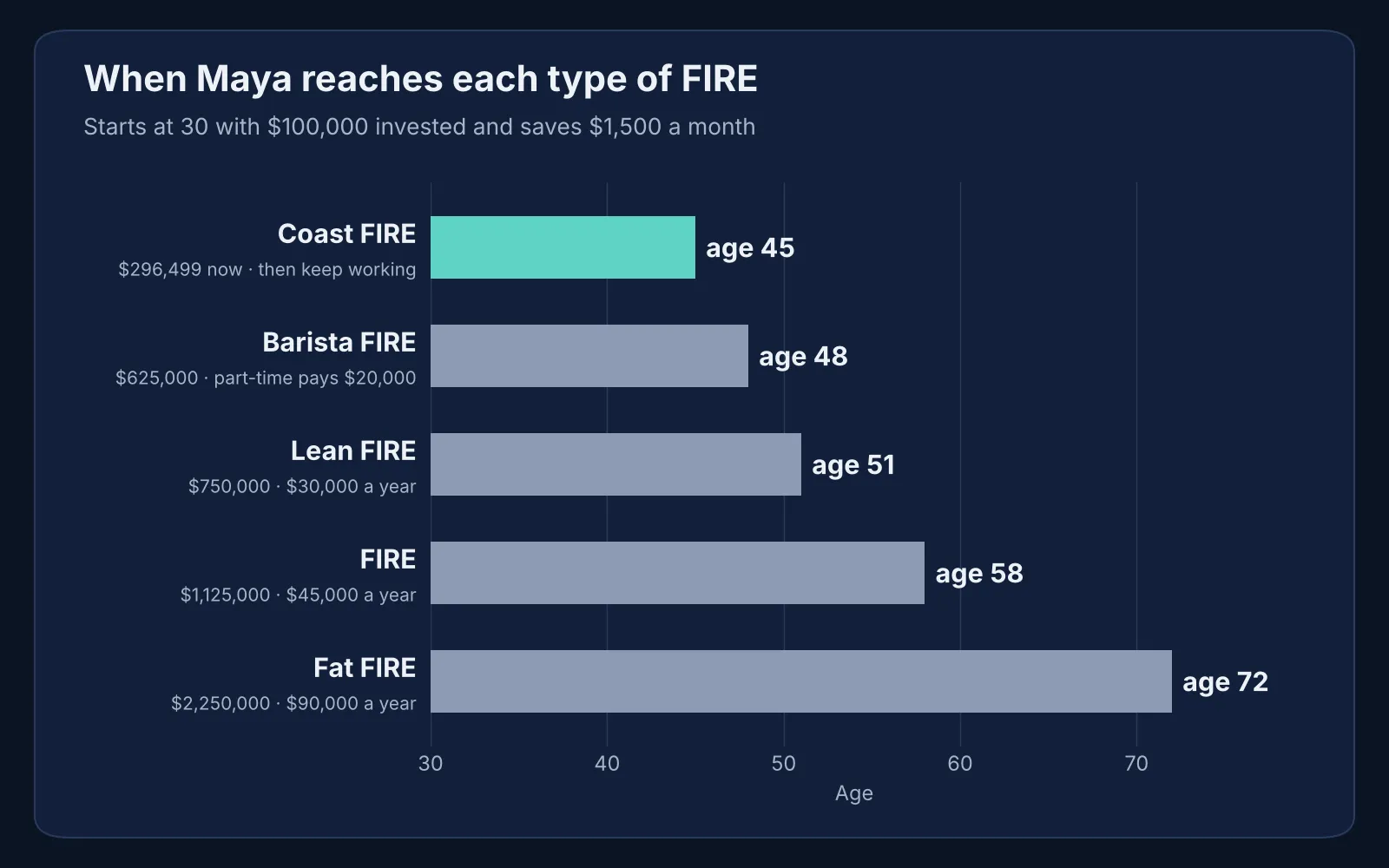
Same person, same saving. Only the goal changes. 7% growth, 3% inflation, 4% withdrawal rate, today’s money.
A few things stand out.
Coast FIRE comes first, at 45. It is the smallest milestone because Maya is not asking her money to pay for anything yet. She is only asking it to keep growing.
Barista FIRE comes three years later, at 48. A part-time income of $20,000 a year cuts her target by $500,000 compared with full FIRE. That is the whole appeal of Barista FIRE: a modest income does a lot of work.
Lean FIRE comes at 51. Spending $15,000 a year less takes seven years off full FIRE. In real life, someone who spends less can usually save more too, so the gap would likely be even bigger. We kept her saving the same so the comparison stays fair.
Full FIRE comes at 58, and Fat FIRE at 72. That last one is worth pausing on. At $1,500 a month, Fat FIRE is not early retirement for Maya at all. It is later than a normal retirement. Fat FIRE usually needs a high income and a high saving rate, not just patience.
A closer look at Coast FIRE
Coast FIRE is a moving target. Each year Maya gets closer to 65, growth has less time to work, so the amount she needs rises. Her balance rises faster, because she is adding $1,500 a month on top of growth.
At 45, the amount needed to coast is $525,075. Maya has $534,412. From then on she could stop saving for retirement completely, and her money would still grow to about $1,145,000 by 65.
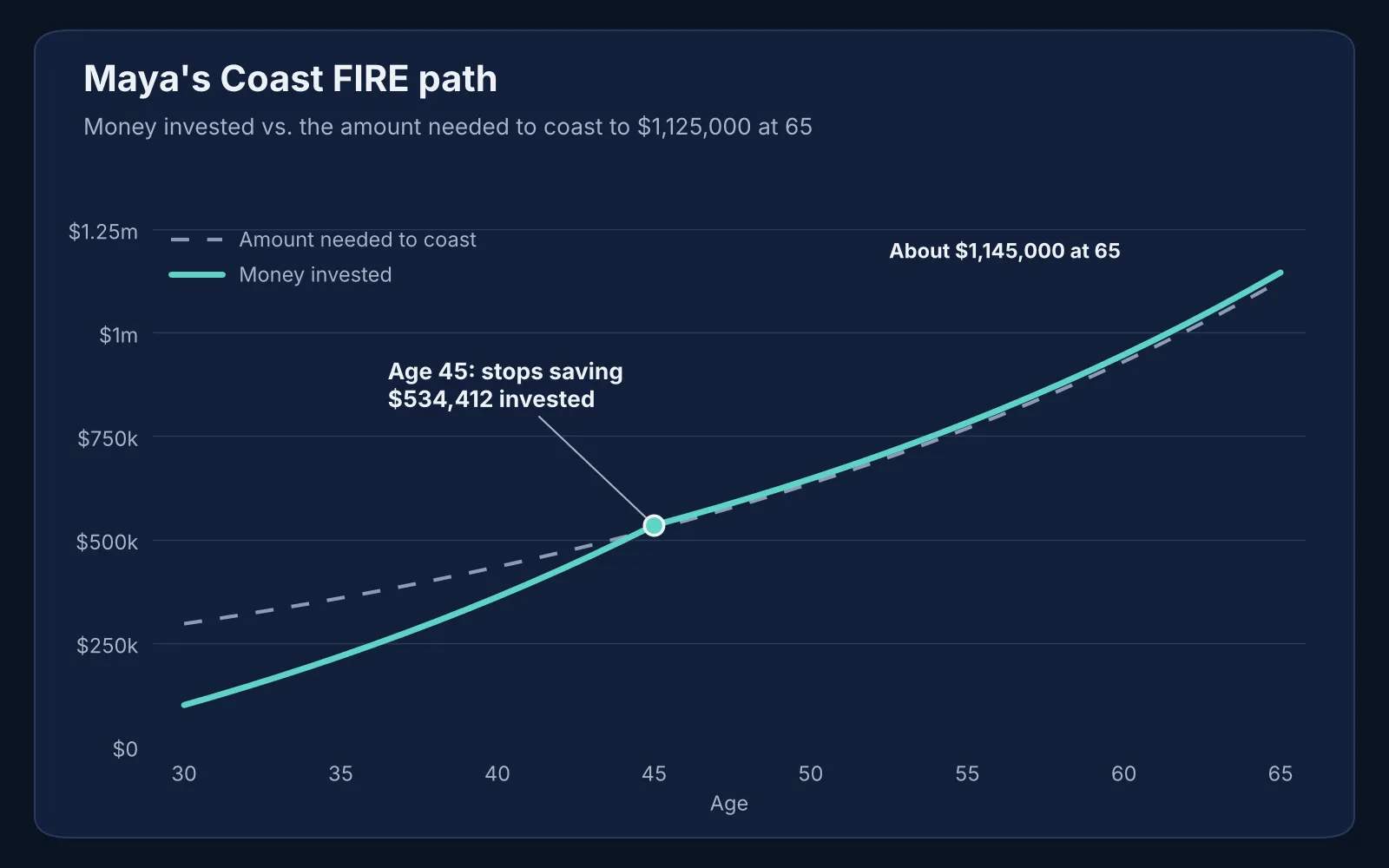
Maya’s money invested (teal) catches the amount needed to coast (dashed) at 45. After that she saves nothing more for retirement.
That is twenty years before she plans to retire. For those twenty years, her pay only has to cover today. If you want the full explanation of how this works, read What is Coast FIRE?
A closer look at Barista FIRE

Barista FIRE is named after the idea of working a few shifts in a coffee shop. You do not need to make coffee. Tutoring, freelance work, three days a week in your old field, or a small business all count. What matters is the money it brings in each year.
Two things to be careful about:
- Your part-time income needs to last. Maya’s $625,000 only works while she earns $20,000 a year. If that work stops, she would need to spend less or draw more from her investments. Many people enter a little less part-time income than they expect, to leave room for this.
- Health cover can matter. In the US, one reason Barista FIRE caught on is that some part-time jobs come with health insurance. Medicare generally starts at 65, according to the US Department of Health and Human Services, so anyone stopping full-time work earlier needs a plan for those years. Rules and costs differ in other countries.
You can work out your own number with the Barista FIRE calculator.
A closer look at Lean FIRE and Fat FIRE
Lean and Fat are the same calculation with different spending. Double your spending and you double the amount you need. That is why the gap between Maya’s Lean FIRE age (51) and Fat FIRE age (72) is so wide.
Neither is better. Lean FIRE gets you out sooner, but leaves less room for bad years, rising prices or a change of plans. Fat FIRE takes longer, but gives you a cushion. Many people end up somewhere in the middle.
If Fat FIRE is your goal, a lower withdrawal rate is worth testing. An early retirement can last 40 years or more. At 3.5% instead of 4%, Maya’s Fat FIRE number rises from $2,250,000 to about $2,571,000. The Fat FIRE calculator lets you try both.
They are not either-or
The four types are often presented as choices you have to pick between. In practice, many people pass through more than one.
A common path looks like this:
- Save hard early until you reach Coast FIRE.
- Stop saving for retirement and use the extra room in your budget: a lower-paid job you enjoy, a career break, or simply spending more today.
- Keep going if you want more. Saving past Coast FIRE moves you towards Barista FIRE or full FIRE sooner.
Coast FIRE also works well for couples. Two incomes can reach it faster, and one partner might cut back while the other keeps working. See Coast FIRE for couples for how to combine your numbers.

Which one fits you?
Ask yourself three questions.
Do you like your work, or at least not mind it? If so, Coast FIRE may be all you need. It takes the pressure off without asking you to leave.
Would you like to work less, but not stop? Barista FIRE is built for that. It is often the most realistic way to leave full-time work before your sixties.
Do you want to stop working completely? Then you are choosing between Lean, full and Fat FIRE. Be honest about what you will really spend. A pension or Social Security can lower the amount you need a lot, because your investments only have to cover the gap.
Whichever you choose, the same three things move every number: how much you spend, how much you save each month, and how many years your money has to grow. If you want to see exactly how the calculator handles each step, the methodology page shows all of it.
Work out your own number
Maya’s numbers are not yours. Your age, savings, spending and pension will change every result above.
Find your Coast FIRE number. It works for singles and couples, includes pensions, and shows every step of the maths with your own figures.
This article is for education, not financial advice. All figures are in today’s money and do not include taxes or fees.
What is your Coast FIRE number?
Find the age you can stop saving for retirement. Free, no sign-up, and your numbers stay on your device.
Find your own Coast FIRE numberPhotos: Rafael Matos, Quang Nguyen Vinh, Marc Majam on Unsplash.