Coast FIRE at 40 or 45: can you still get there if you start late?
By Gourav Boruah · October 24, 2026 · 9 min read

Yes, you can still reach Coast FIRE at 40 or 45. It just comes later than it would at 25, often in your 50s rather than your 30s. For example, someone who is 40 with $60,000 invested, saving $1,000 a month and expecting a $20,000 pension can usually stop saving for retirement at 60. Saving a bit more, spending a bit less or working two more years can bring that down to the early 50s.
Want your own number first? Use the Coast FIRE calculator. It takes a minute and nothing is sent anywhere.
If “Coast FIRE” is new to you, start with what Coast FIRE is. In short: it is the point where the money you already have can grow into your full retirement pot on its own, so you can stop saving for retirement and only earn enough to pay for today.
Why Coast FIRE at 40 is different
The goal does not change with age. What changes is how long your money has to grow.
At 7% growth and 3% inflation, money grows about 3.88% a year faster than prices. Over time that adds up:
- From 40 to 67 (27 years), $1 today grows to about $2.80.
- From 45 to 67 (22 years), $1 today grows to about $2.31.
- From 30 to 67 (37 years), it would have grown to about $4.09.
So at 40, each dollar does less of the work and your own saving has to do more. The door is not closed. The plan just leans more on saving and on a few choices you still control. Coast FIRE number by age has tables for the amount needed at each age.
A worked example: Maria at 40
Meet Maria. She is 40, and she only started taking retirement seriously a few years ago. She has $60,000 invested and puts in $1,000 a month.
She wants to spend $45,000 a year in retirement, in today’s money. She plans to retire at 67 and expects a state pension (or Social Security) of about $20,000 a year from then.
She uses the calculator’s defaults: 7% growth, 3% inflation and a 4% withdrawal rate. The withdrawal rate is the share of the pot you take out each year in retirement.
Step 1: The pot she needs at 67. ($45,000 − $20,000) ÷ 0.04 = $625,000.
Step 2: Real growth. (1 + 0.07) ÷ (1 + 0.03) − 1 = 3.88% a year. This is growth after inflation.
Step 3: How much $1 grows to in 27 years. 1.0388 to the power of 27 = about 2.80.
Step 4: Her Coast FIRE number today. $625,000 ÷ 2.80 = about $223,000 (the calculator’s exact figure is $223,420.53).
With $60,000, she is 26.9% of the way there. That gap looks big. But she is not standing still: she adds $12,000 a year, and her money grows too. If she keeps going, she catches up at 60, with $481,601.12 invested. After that, growth alone takes her to about $628,801.20 by 67, a little more than she needs.
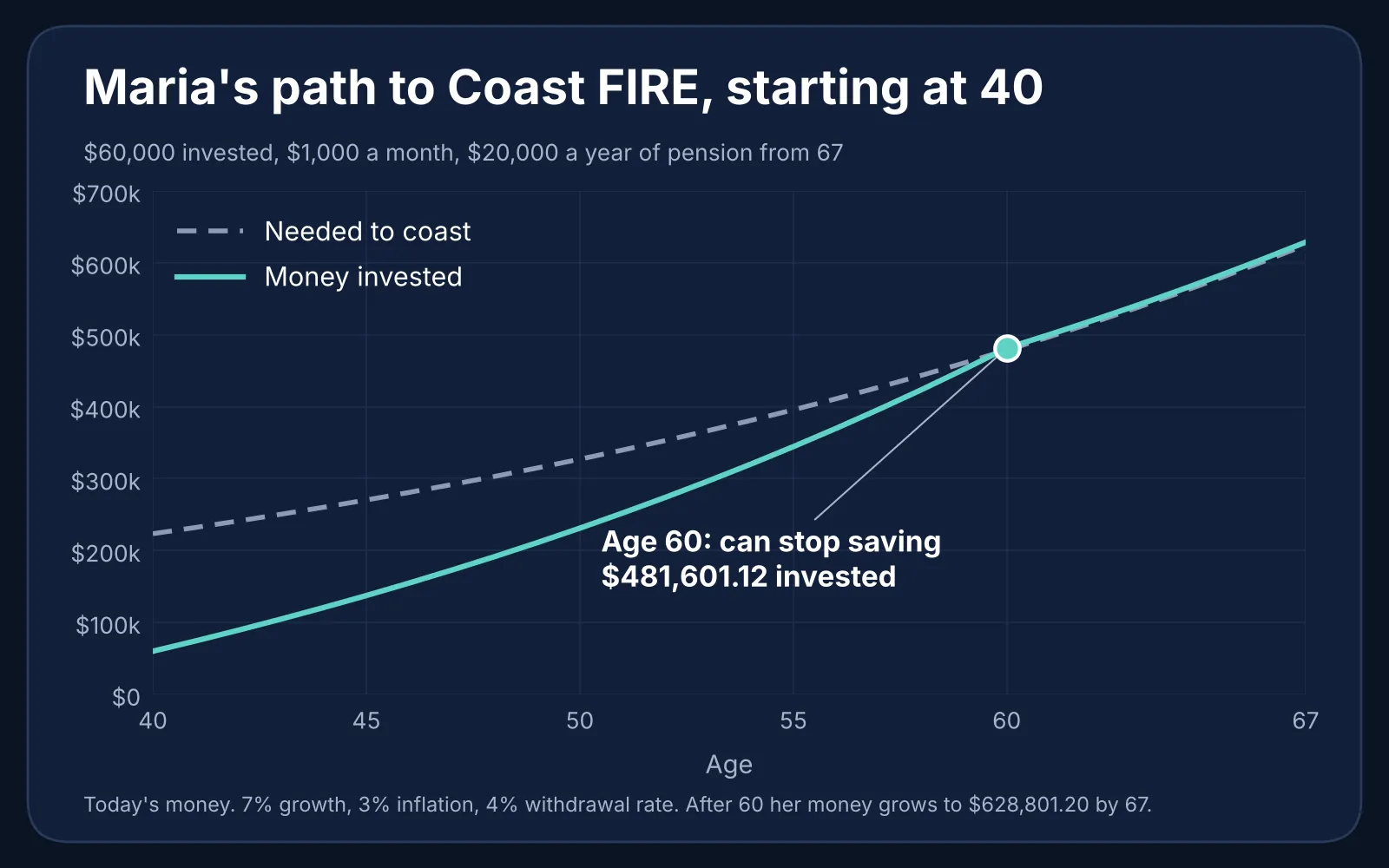
Her money invested (teal) meets the amount needed to coast (dashed) at 60. From then on, growth does the rest.
For comparison: if Maria had the same $60,000 and saved the same $1,000 a month from 30, she could have stopped at 40. Starting ten years later pushes her stop-saving age back by twenty years. This is not a reason to feel bad. It is a reason to look closely at the levers below, because at 40 each one matters more.
Five ways to stop saving sooner
Here is Maria again, changing one thing at a time. Everything else stays the same.
| What she changes | Pot needed at 67 | She can stop saving at |
|---|---|---|
| Nothing (her starting plan) | $625,000 | 60 |
| Saves $300 more a month ($1,300) | $625,000 | 54 |
| Saves $500 more a month ($1,500) | $625,000 | 52 |
| Spends $40,000 a year instead of $45,000 | $500,000 | 53 |
| Retires at 69 instead of 67 | $625,000 | 57 |
| Spends $40,000 and retires at 69 | $500,000 | 51 |
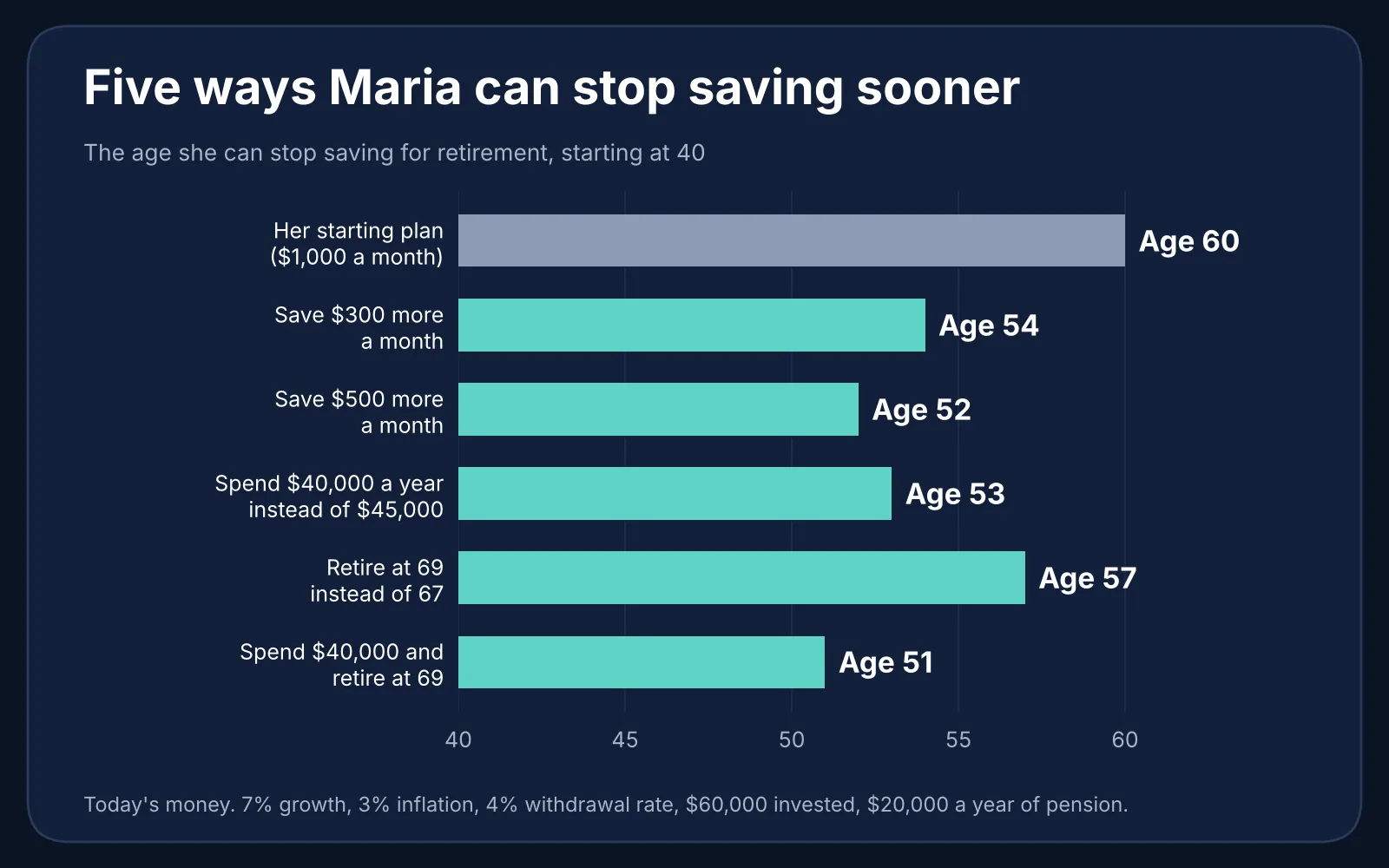
Small changes move a late start a long way. The biggest wins come from spending less in retirement and saving a little more now.
What each lever does, in plain words:
- Save a bit more now. An extra $300 a month brings her stop-saving age from 60 to 54. Early in your 40s, extra saving still has 20 or more years to grow.
- Plan to spend a bit less. Cutting her retirement spending by $5,000 a year shrinks the pot she needs by $125,000 ($5,000 ÷ 0.04). That brings her to 53. Every $1 a year less you need to spend saves $25 in the pot.
- Work a little longer. Retiring at 69 gives her money two more years to grow, and she stops saving at 57.
- Count your pension carefully. Her $20,000 pension saves her $500,000 of pot ($20,000 ÷ 0.04). That is huge, so it is worth finding out what yours will really be. Coast FIRE with a pension shows how to count one safely.
- Combine them. Two modest changes together, spending $40,000 and retiring at 69, bring her to 51.
One warning: retiring earlier works the other way. If Maria retires at 65 instead, she has to keep saving until 64. And the calculator assumes her pension starts the day she retires, which may not be true at 65, so the real picture would be tighter still.

Starting at 45: Dan’s honest numbers
Now meet Dan. He is 45, has $40,000 invested, saves $900 a month and wants $40,000 a year from 67. He expects a pension of about $18,000 a year.
Pot needed at 67: ($40,000 − $18,000) ÷ 0.04 = $550,000. $1 grows to in 22 years: 1.0388 to the power of 22 = about 2.31. Coast FIRE number today: $550,000 ÷ 2.31 = about $238,000 (exactly $237,869.37). He is 16.8% of the way there.
Here is the honest part. At $900 a month, Dan never reaches Coast FIRE before 67. He keeps saving all the way and ends up with about $457,408.73, which is $92,591.27 short of the $550,000 he needs.
That is not the end of the story. It tells him which levers to pull:
- Save $1,300 a month instead of $900. He can stop saving at 63, with enough for the full pot.
- Plan to spend $36,000 a year instead of $40,000. The pot he needs falls to $450,000, and his current saving just gets him there at 67. He reaches his goal, but he never gets to coast.
- Do both. Saving $1,300 a month and planning to spend $36,000 lets him stop saving at 58.
- Work to 70 on his current saving. On its own, that is still not quite enough: about $546,469.93 against the $550,000 he needs. Working longer helps, but alone it was not the strongest lever for Dan.
For Dan, the plan is less about stopping early and more about knowing where he stands, while there is still time to act.
Catch-up contributions: extra room after 50
Some countries let older savers put more into tax-advantaged retirement accounts. In the United States, for 2026, the 401(k) limit is $24,500, and people aged 50 and over can add a catch-up of $8,000 more. For ages 60 to 63 the catch-up is $11,250 instead. The IRA limit is $7,500, plus $1,100 extra from age 50, according to the IRS.
Other countries have their own rules and limits, and they change often. Check your government’s official pages before you plan around them. Whatever account you use, the calculator only needs two things: how much you have and how much goes in each month.
When Coast FIRE comes late: what it still gives you
If the calculator says you will coast at 58 or 60, it can feel hardly worth it. But a late coast age still gives you a finish line: knowing you must save $1,300 a month until 54 beats saving “as much as possible” forever. And from that age on, any extra saving is a bonus. You could work part-time, move to work you enjoy more, or spend more on today.
If stopping all saving feels too far away, a middle path may suit you better: working fewer hours and letting part-time pay cover part of your costs. The Barista FIRE calculator shows how that works.
Coast FIRE at 40 or 45: questions people often ask
Is 40 too late for Coast FIRE? Usually not. You need more invested than at 25 or 30, and you will likely stop saving later, often in your 50s. A pension, a realistic spending figure and steady saving matter more than they would earlier.
How much do I need at 40 for Coast FIRE? It depends on your spending, pension and retirement age. For Maria, wanting $45,000 a year with a $20,000 pension at 67, it is $223,420.53. Yours could be higher or lower, so run your own figures.
Should I take more risk to catch up? This article cannot tell you how to invest. What the maths does show is that a big fall close to retirement leaves little time to recover, so it makes sense to test your plan with modest growth and lean on the levers you control: saving, spending and when you retire.
What if my growth is lower than 7%? At 6% growth, Maria would not reach Coast FIRE before 67 on $1,000 a month. Test a lower rate too, and a 3.5% withdrawal rate. The 4% rule explained shows why some people use it.
We are a couple in our 40s. Does this change? The maths is the same. Add both pots, both monthly savings and both pensions. Coast FIRE for couples shows how to plan with two ages.
Six steps to take today
- Add up everything you have invested for retirement, across all accounts.
- Work out what goes in each month, including anything your employer adds.
- Check your expected state or work pension on your government’s or employer’s official pages.
- Pick a realistic yearly spending figure for retirement, in today’s money.
- Open the calculator and enter your figures to see your Coast FIRE number and stop-saving age.
- Change one lever at a time: $200 more a month, $5,000 less spending, retiring two years later. See which one moves your age the most.
Every setting is explained on the methodology page.
Work out your own number
Starting late changes the timing, not the idea. Your number depends on your spending, your pension, when you retire and the gap between growth and inflation you choose. Two or three versions side by side tell you more than any single answer.
Find your Coast FIRE number. It works for singles and couples, includes pensions, and shows every step of the maths with your own figures.
This article is for education, not financial advice. All figures are in today’s money and do not include taxes or fees.
What is your Coast FIRE number?
Find the age you can stop saving for retirement. Free, no sign-up, and your numbers stay on your device.
Find your own Coast FIRE numberPhotos: Arina Krasnikova, Gary Barnes on Unsplash.