Why 7% growth is not really 7%: inflation and real growth in plain English
By Gourav Boruah · October 19, 2026 · 8 min read

If your investments grow 7% a year but prices rise 3% a year, your money only buys about 3.88% more each year. That is your real growth, and it is the number that decides your Coast FIRE date. Get it wrong and your Coast FIRE number can look less than half of what it really is.
Want your own number first? Use the Coast FIRE calculator. It takes a minute and nothing is sent anywhere.
What inflation does to your money
Inflation is the slow rise in prices. If a loaf of bread costs $1.00 this year and $1.03 next year, inflation is 3%.
That sounds small. Over a working life, it is not. At 3% a year:
- $100 today buys about $41.20 worth of today’s shopping in 30 years. The note is the same. What it buys is less than half.
- Someone who wants to spend $40,000 a year in today’s money will need about $97,090 a year in 30 years’ time to buy the same things.
So when you plan for retirement, there are two ways to write down the same amount:
- Future money (also called “nominal”): the actual number on your statement in the future.
- Today’s money (also called “real”): what that future number would buy at today’s prices.
Our calculator works in today’s money. Your spending, your pension and your Coast FIRE number are all shown at today’s prices, so they are easy to picture. To do that fairly, it has to take inflation out of the growth too.
How to work out real growth
Here is the sum the calculator uses:
Real growth = (1 + growth) ÷ (1 + inflation) − 1
With the standard settings:
(1 + 0.07) ÷ (1 + 0.03) − 1 = 1.07 ÷ 1.03 − 1 = 0.0388, or 3.88% a year.
Why not just take 3 from 7 and call it 4%? Because inflation also eats into this year’s growth, not only the money you started with. Subtracting is a fine rough guide in your head. For a 30-year plan, the small gap adds up. We will see how much in a moment.
Here is what it means for $100,000 left alone for 30 years:
| Growth used | After 30 years | |
|---|---|---|
| On your statement (future money) | 7% | $761,226 |
| What it buys (today’s money) | 3.88% | $313,615 |
Both rows are true. The first is the number you will see. The second is what it will feel like when you spend it.
The trap: is your 7% already “real”?
This is the part most guides skip, and it is where many plans go wrong.
You will often read that shares “return about 7% a year”. Some writers mean 7% after inflation. Others mean 7% before inflation. Different calculators make different choices too. Some ask for a real return and have no inflation box at all. Ours asks for growth before inflation and takes inflation off separately.
Mixing them up causes one of two mistakes:
- Counting inflation twice. You enter a real return, such as 7% after inflation, into a calculator that then takes inflation off again. Your plan looks worse than it is.
- Not counting inflation at all. You enter growth before inflation into a calculator that does not take inflation off, while your spending is in today’s money. Your plan looks much better than it is. This is the more dangerous mistake.
A quick test: if the calculator has no inflation box, it expects a real return. If it has one, like ours, enter growth before inflation.
Where 7% comes from
For a sense of scale, data kept by NYU professor Aswath Damodaran shows that $100 put into the US S&P 500 at the start of 1928 had grown to about $787,000 by the end of 2023, with dividends reinvested. That works out at roughly 9.8% a year before inflation.
So 7% before inflation is a deliberately careful figure. It leaves room for fees, for investments that hold some bonds, and for the fact that many markets outside the US have done less well. Nobody knows future returns. Past results are a guide, not a promise.
On the inflation side, the US Federal Reserve aims for 2% a year over the long run, and the UK government sets the Bank of England a 2% target. Targets are not always hit, as the last few years showed. Some countries, such as India, have higher inflation. The calculator’s 3% gives a little room above the 2% targets.
A worked example: Ben at 35

Meet Ben. He is 35, has $100,000 invested and saves $1,000 a month. He wants to spend $40,000 a year from 65, in today’s money. He expects a pension of $10,000 a year, so his investments need to cover the other $30,000.
We use the calculator’s standard settings: 7% growth, 3% inflation and a 4% withdrawal rate.
Step 1: The pot he needs at 65. ($40,000 − $10,000) ÷ 0.04 = $750,000.
Step 2: Real growth. (1 + 0.07) ÷ (1 + 0.03) − 1 = 3.88% a year.
Step 3: How much $1 grows to in 30 years. 1.0388 to the power of 30 = 3.136. Every dollar Ben has today becomes about $3.14 by 65, in today’s money.
Step 4: His Coast FIRE number today. $750,000 ÷ 3.136 = $239,147.
With $100,000 invested, Ben is 42% of the way there. If he keeps saving $1,000 a month, he catches up at 51, with $443,434 invested. From then on he can stop saving for retirement, and growth alone takes his money to about $755,928 by 65.
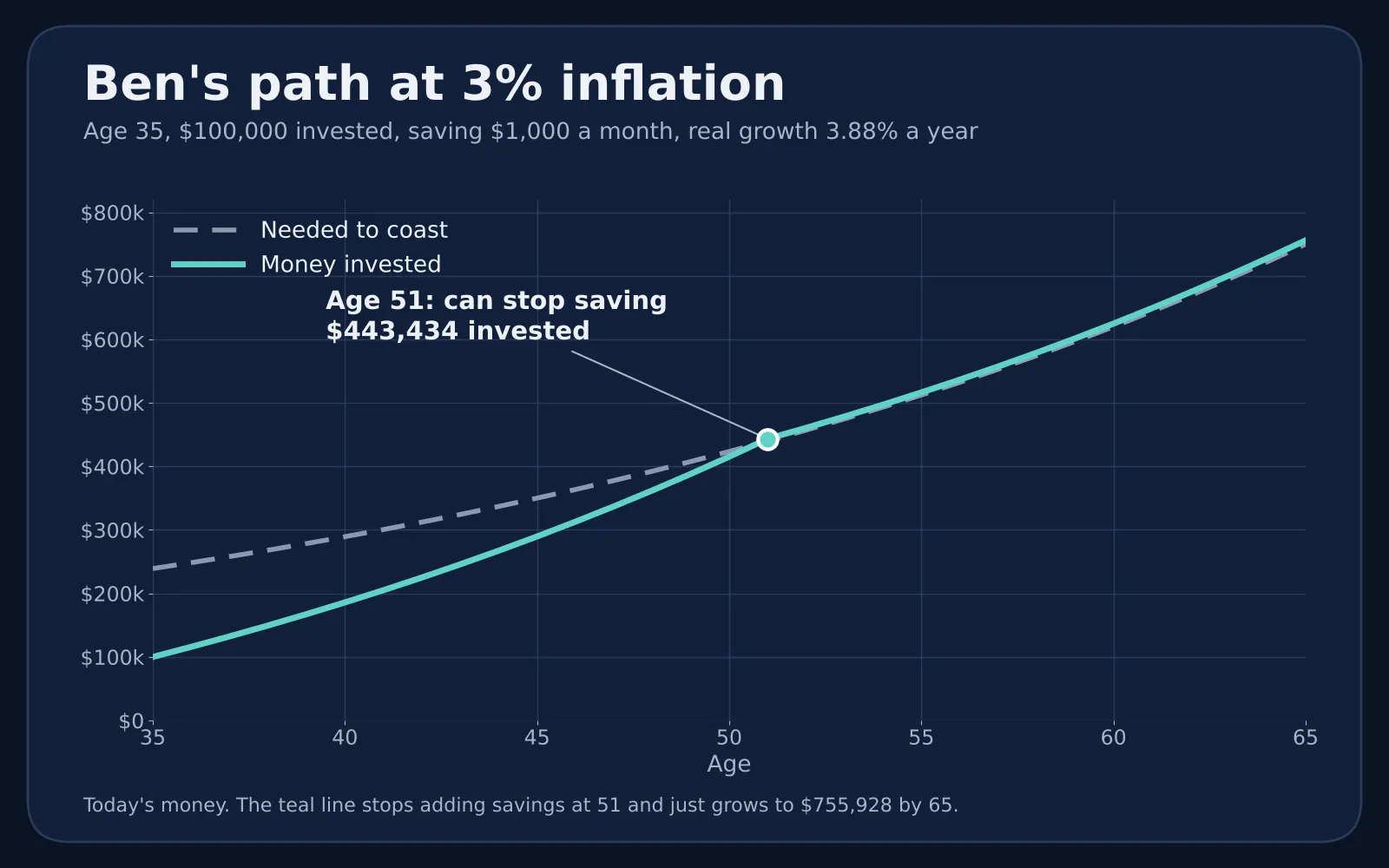
Ben’s money invested (teal) meets the amount needed to coast (dashed) at 51. After that, he adds nothing more.
What if Ben forgot about inflation?
Now say Ben used 7% growth and did not take inflation off at all. His Coast FIRE number would be $750,000 ÷ 1.07 to the power of 30 = $98,525. He would think he had already reached Coast FIRE today, at 35, and could stop saving.
He would be wrong by more than $140,000. If he stopped saving now, his pot at 65 would buy far less than he needs.
Here is how much the inflation figure changes things, with everything else kept the same:
| Inflation | Real growth | Coast FIRE number today | Ben can stop saving at |
|---|---|---|---|
| None (7% treated as real) | 7.00% | $98,525 | 35 (already there) |
| 2% | 4.90% | $178,465 | 44 |
| 3% | 3.88% | $239,147 | 51 |
| 4% | 2.88% | $319,557 | 62 |
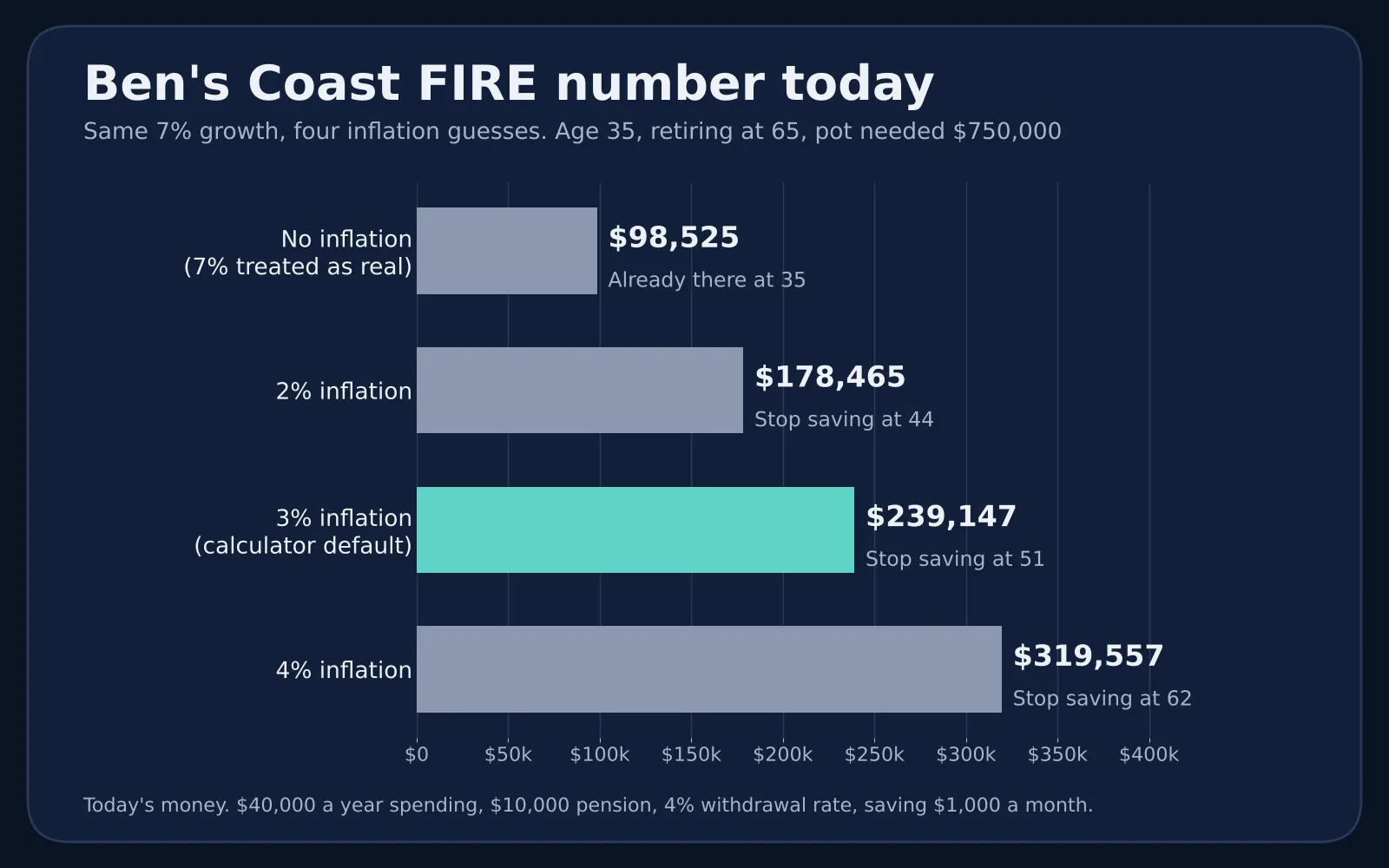
One percentage point of inflation moves Ben’s stop-saving age by seven to eleven years.
And the shortcut of just subtracting, 7% − 3% = 4%, would give a Coast FIRE number of $231,239. That is about $7,900 lower than the proper sum. Close, but not the same.
How Ben can plan for higher inflation
Ben worries that 3% might be too low. At 4% inflation he would have to save until 62. A little more each month closes most of that gap:
| Ben saves | Stop-saving age at 4% inflation |
|---|---|
| $1,000 a month | 62 |
| $1,200 a month | 56 |
| $1,500 a month | 51 |
So if he saves $1,500 a month, he can still stop at 51 even if inflation runs at 4%. That is a choice he can make today, with his eyes open.
Three things to check in your own plan
- Your spending is in today’s money. Write down what you would spend at today’s prices. Do not try to guess future prices. The calculator handles that.
- Your growth figure is before inflation. If you have read that shares make “7% after inflation”, either enter a higher growth figure with inflation, or set inflation to 0%. Do one or the other, never both.
- Your pension keeps up with prices. The calculator treats your pension as today’s money. Many state pensions rise with prices each year, but some work pensions do not, or only partly. If yours is fixed, its real value will shrink over time, so enter a lower figure to be safe. Coast FIRE with a pension explains how to count one.

Which inflation figure should you use?
There is no right answer, only a sensible range. A simple way to choose:
- Open the calculator and run your plan with the standard 3%.
- Tap Change next to the assumptions and try 2%, then 4%.
- Note your stop-saving age each time.
- If the ages are close, keep 3% and move on.
- If they are far apart, like Ben’s, plan for the higher figure or add a little to your monthly saving.
- Check again once a year. Inflation and your own costs both change.
Inflation works on the bottom of the Coast FIRE sum, just like the withdrawal rate. If you want to see how the two choices stack up, read the 4% rule explained. For a table of numbers by age at the standard settings, see Coast FIRE number by age.
What real growth does not tell you
- It is an average. Real markets jump around. Some years will be far above 3.88%, some far below zero.
- Your own inflation is personal. If you spend a lot on rent, care or school fees, your prices may rise faster than the national figure.
- It ignores taxes and fees. A 1% yearly fee would come straight off your real growth.
Every setting our calculator uses is explained on the methodology page.
Work out your own number
Run your plan at 2%, 3% and 4% inflation. Seeing the three stop-saving ages side by side is the quickest way to know how much inflation could cost you.
Find your Coast FIRE number. It works for singles and couples, includes pensions, and shows every step of the maths with your own figures.
This article is for education, not financial advice. All figures are in today’s money and do not include taxes or fees.
What is your Coast FIRE number?
Find the age you can stop saving for retirement. Free, no sign-up, and your numbers stay on your device.
Find your own Coast FIRE numberPhotos: Land O'Lakes, Inc., Jud Mackrill, Land O'Lakes, Inc. on Unsplash.