Coast FIRE and a market crash: what a fall really does to your plan
By Gourav Boruah · October 29, 2026 · 10 min read

A market crash shrinks the money you have today, but it does not change the pot you need at retirement or your Coast FIRE number. What it changes is the age you can stop saving: that moves later, sometimes by years, until prices recover or you make up the gap. It only becomes a real problem if you have already stopped saving with no room to spare, and even then you have simple ways back.
Want your own number first? Use the Coast FIRE calculator. It takes a minute and nothing is sent anywhere.
New to the idea? What is Coast FIRE covers the basics. In short: Coast FIRE is the point where the money you already have can grow into your full retirement pot on its own, without any more saving.
What a crash changes, and what it does not
When prices fall, it is easy to feel the whole plan is broken. Most of it does not move at all:
| Part of your plan | Does a crash change it? |
|---|---|
| What you will spend in retirement | No |
| Your pension | No |
| The pot you need at retirement | No |
| Your Coast FIRE number today | No |
| The money you have invested today | Yes, it falls |
| The age you can stop saving | Yes, it moves later |
So a crash is one number going down: your balance. The goal stays where it was. The question is only how far behind the goal you now are, and what it takes to catch up.
A worked example: Dan at 40
Meet Dan. He is 40, has $160,000 invested for retirement and saves $600 a month. He wants to retire at 67, expects to spend $44,000 a year in today’s money, and expects a pension (or Social Security) of about $18,000 a year.
Here is his plan before any crash, using the calculator’s defaults: 7% growth, 3% inflation and a 4% withdrawal rate.
Step 1: The pot he needs at 67. ($44,000 − $18,000) ÷ 0.04 = $650,000.
Step 2: Real growth. (1 + 0.07) ÷ (1 + 0.03) − 1 = 3.88% a year. That is growth after inflation. Why 7% growth is not really 7% explains this step.
Step 3: How much $1 grows to in 27 years. 1.0388 to the power of 27 = about 2.797.
Step 4: His Coast FIRE number today. $650,000 ÷ 2.797 = about $232,357 (the calculator’s exact figure is $232,357.36).
Dan has $160,000, so he is 68.9% of the way there. Saving $600 a month, he reaches Coast FIRE at 53.
Now the market falls 35%
Say the market drops and Dan’s $160,000 becomes $104,000. His Coast FIRE number is still $232,357, because nothing about his goal changed. But he is now only 44.8% of the way there.
If he changes nothing and keeps saving $600 a month, his money never catches the “needed to coast” line before 67. He would have to keep saving all the way, and he would reach about $624,172 at 67.
That is the scary part. Here is the calming part: $624,172 is still about 96% of his $650,000 goal, around $25,828 short. A 35% fall did not wreck his retirement. It took away his early stop-saving age.
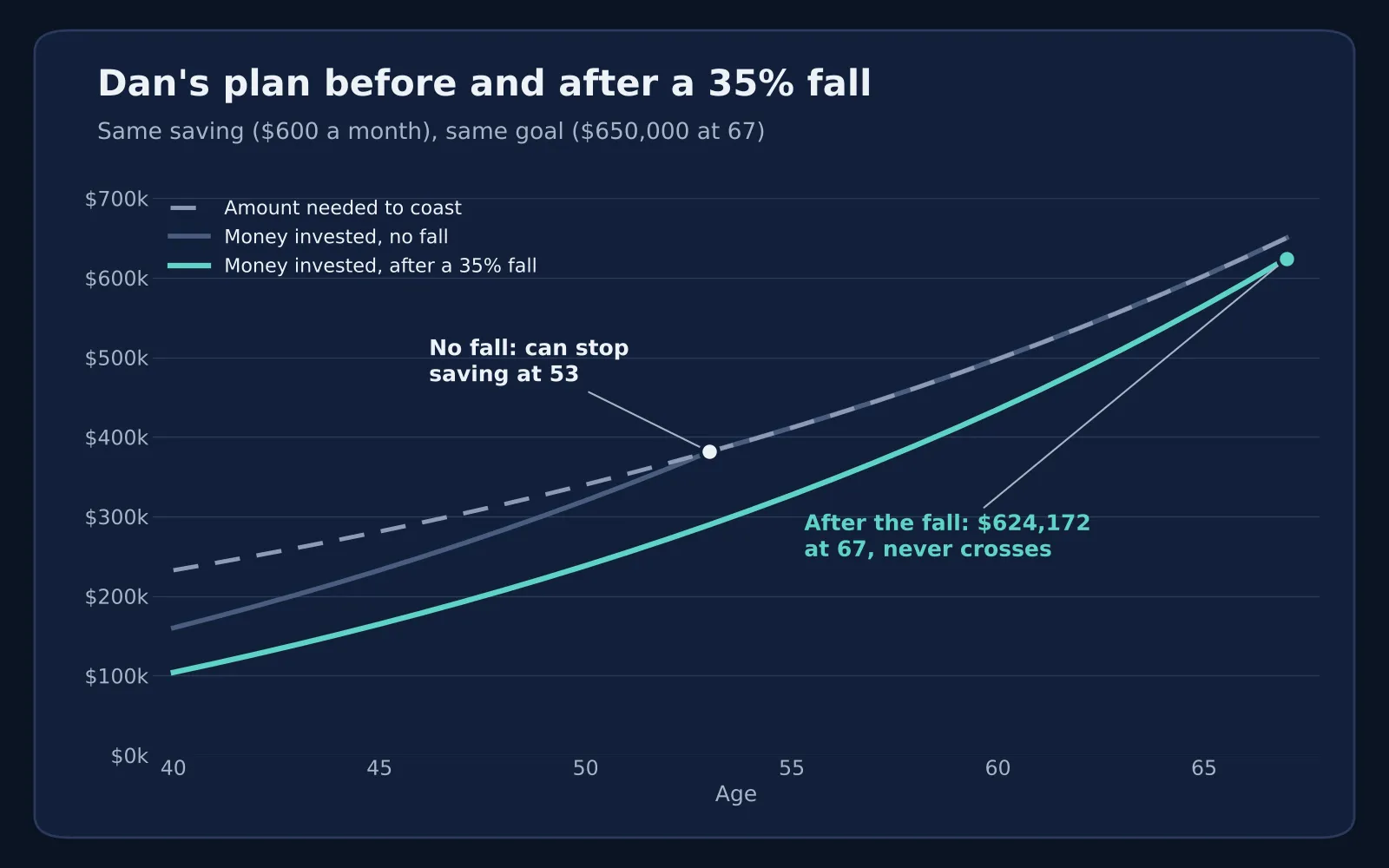
After a 35% fall, Dan’s money no longer meets the amount needed to coast before 67, but it ends only about 4% short.
Why the calculator’s picture is the gloomy one
When you type your new, lower balance into the calculator, it assumes steady growth from that lower point. In other words, it treats the fall as permanent. That is a cautious way to look at it.
In real life, prices have often recovered after big falls. If the market climbs back to where it would have been, Dan’s money goes back towards his original line, and his stop-saving age moves back towards 53. The $600 he keeps investing each month while prices are low also buys more than usual, which helps once prices rise again. None of this is promised, which is why it is worth knowing what you would do if the recovery is slow.

Four ways back on track after a crash
If Dan does not want to rely on a recovery, he has a few levers. Each one is a setting in the calculator:
| What Dan does | Age he can stop saving |
|---|---|
| Nothing has fallen (his original plan) | 53 |
| Change nothing after the fall | Not before 67 |
| Plan to spend $42,000 a year instead of $44,000 | 64 |
| Save $900 a month | 57 |
| Save $1,000 a month | 55 |
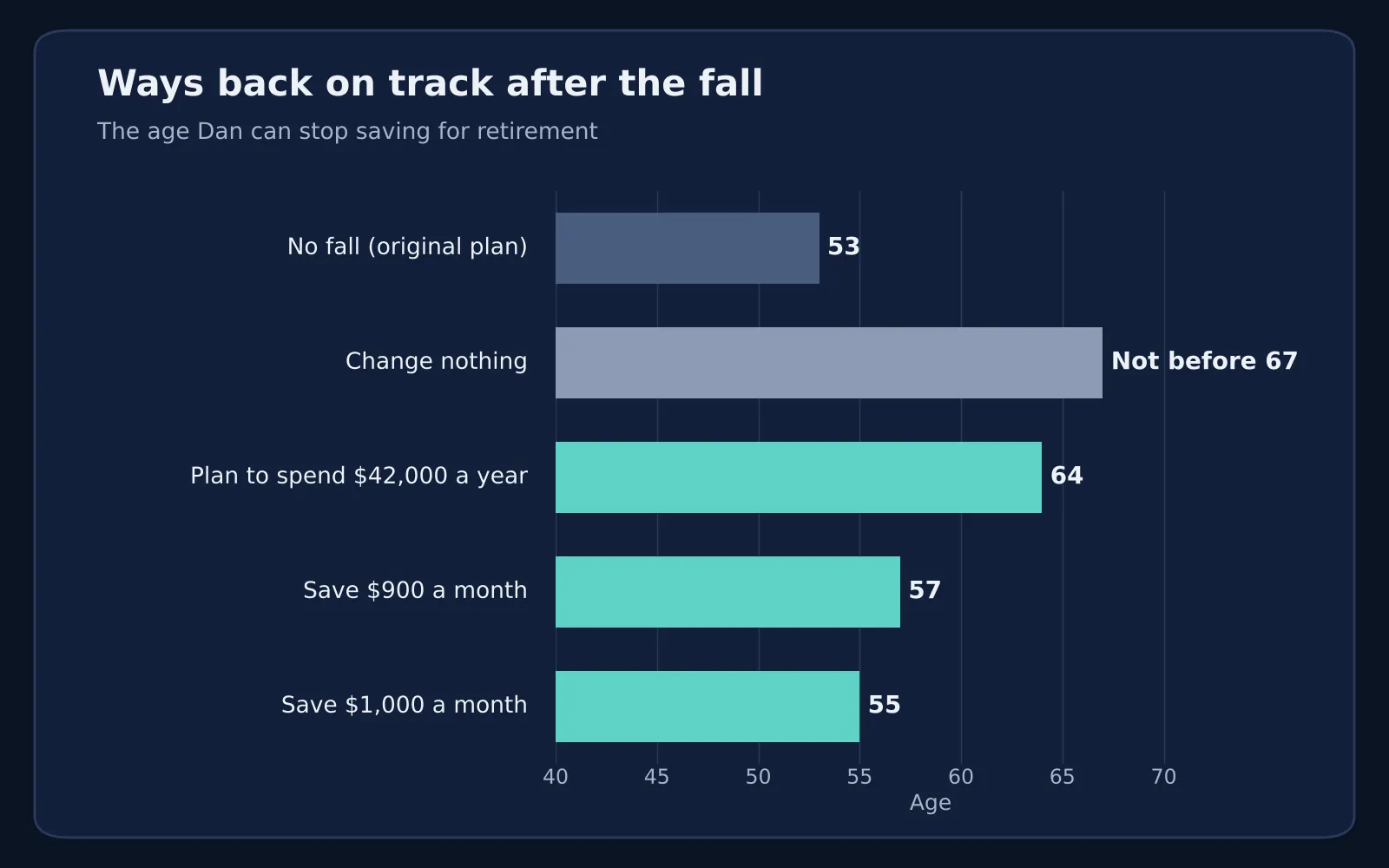
Saving a little more for a few years is the fastest way back for Dan.
A few things stand out:
- Saving more works fastest. An extra $300 to $400 a month pulls his stop-saving age back to the mid-50s.
- Spending less helps, but slowly. Cutting his plan by $2,000 a year lowers his pot to $600,000 and gets him there at 64.
- Waiting for a recovery costs nothing extra, but you do not control when it comes. You can also mix levers and re-check in a year.
If you have already stopped saving
This is the case that worries people most. Meet Lena. She is 50, with the same spending, pension and retirement age as Dan. Her Coast FIRE number at 50 is $340,112. She had exactly that, so she stopped saving for retirement.
Then the market falls 35% and her money drops to about $221,073, or 65% of her number. If prices never recovered and she never saved again, she would reach only about $422,500 at 67, well short of $650,000.
What can she do?
- Wait and watch. If the market recovers, she is back on track with no change. One option is to check again in six or twelve months before changing anything.
- Restart some saving. Saving $1,000 a month would get her back to Coast FIRE at 63. Saving $1,500 a month would do it at 58, even if prices never recover.
- Pick up a little extra work. If she had moved to part-time work, a few more hours or a slightly later full stop can close the gap. Coast FIRE, part-time work and career breaks covers this, and the Barista FIRE calculator lets you test it.
The lesson is not that Lena did something wrong. It is that stopping right on the line leaves no room for a bad year. What to do after Coast FIRE talks about keeping a margin before you stop completely.
Would a cushion have made her crash-proof? Not fully. If she had stopped with 20% more than her number, a 35% fall that never recovered would still leave her at about 78% of her goal. A cushion softens a crash; it does not cancel one. That is why a plan B matters as much as the cushion.
How long do market crashes last?
Nobody knows in advance. History gives a rough feel, but it is not a promise.
Using US stock market data with dividends reinvested, from DQYDJ’s S&P 500 drawdown history:
- 2007 to 2009: the market fell about 49% from its October 2007 peak and did not reach a new high until August 2012, almost five years after the peak.
- 2000 to 2003: a fall of about 42%, with a new high in October 2006.
- 2020: a sharp drop of roughly a third in a few weeks, with a new high by August 2020.
Some falls are over in months, some take years, and other countries’ markets have had longer slumps than these. If your Coast FIRE date is ten or twenty years away, you have time for a recovery. If you are close to retiring, a long slump matters much more.
Should you keep investing during a crash?
This is a personal decision, and we cannot make it for you. A few points that may help you think it through:
- Selling after a fall locks in the loss. If you sell, you no longer own what might recover.
- Regular saving buys more when prices are low. The same $600 buys more of a fund when its price has fallen.
- Big decisions made in a panic are often regretted. The US regulator FINRA’s tips for turbulent markets suggest tying your investing to a long-term plan and avoiding impulsive decisions when markets swing.
- Your safety net matters more than ever. If a crash comes with a job loss, cash savings stop you having to sell investments at low prices.
Sequence of returns risk, in plain English
You may see the phrase “sequence of returns risk”. It means that the order of good and bad years matters once you start taking money out. A crash right after you retire hurts more, because you sell more of your investments at low prices to pay for living costs, and that money is not there for the recovery.
During your coast years, you are not taking money out. A crash mostly just delays things. The risk grows as you get close to retirement, which is one reason some people use a lower withdrawal rate. The 4% rule explained covers when 3.5% may suit you better.

Build a crash cushion today
You cannot stop a crash, but you can make one much less stressful. Here is what you can do this week:
- Run your plan in the calculator now, while things are calm, and write down your Coast FIRE number and stop-saving age.
- Test a tougher world. Try 6% growth instead of 7%. For Dan, that raises his Coast FIRE number today from $232,357 to $299,406. If that version still looks fine to you, a bad decade will feel less scary.
- Keep a cash safety net for emergencies, so you are never forced to sell after a fall.
- Leave a margin before you stop saving completely, or keep saving a small amount after you reach your number.
- Write down your plan B. Which lever would you pull first: save more, work a little longer, or spend a little less?
- Check once or twice a year, not every day. Daily prices tell you very little about a plan that runs for decades.
Coast FIRE and market crashes: questions people ask
Do I lose Coast FIRE if the market crashes? You may drop below your number for a while. Your goal does not change, only your balance. If prices recover, you can be back over the line without doing anything. If they do not, you have levers: save a bit more, spend a bit less, or work a bit longer.
Should I lower my growth rate after a crash? One bad year does not change long-term growth on its own. But it is sensible to test a lower rate, such as 6%, to see how much room you have. Every setting is explained on the methodology page.
Should I update the calculator during a crash? Yes, it is useful to see where you stand. Just remember it treats your lower balance as permanent, so it shows the cautious picture.
Work out your own number
In a Coast FIRE plan, a crash is usually a delay, not a disaster, and you now know which levers to pull.
Find your Coast FIRE number. It works for singles and couples, includes pensions, and shows every step of the maths with your own figures. Try your balance 35% lower, then try saving a little more, and see how quickly you get back on track.
This article is for education, not financial advice. All figures are in today’s money and do not include taxes or fees.
What is your Coast FIRE number?
Find the age you can stop saving for retirement. Free, no sign-up, and your numbers stay on your device.
Find your own Coast FIRE numberPhotos: SHVETS production, Mikhail Nilov, Marc Majam on Unsplash.