Coast FIRE, part-time work and career breaks: what they really cost
By Gourav Boruah · October 27, 2026 · 9 min read

Yes, you can take a career break or switch to part-time work and still reach Coast FIRE. If you take a break before you reach your Coast FIRE number, it usually pushes back the age you can stop saving by about the length of the break, as long as you leave your investments alone. If you take it after you reach Coast FIRE, it costs your retirement pot nothing at all. The real damage comes from spending your investments during the break, and from gaps in your state pension.
Want your own number first? Use the Coast FIRE calculator. It takes a minute and nothing is sent anywhere.
New to the idea? What is Coast FIRE covers the basics. In short: Coast FIRE is the point where the money you already have can grow into your full retirement pot on its own, without any more saving.
The short answer: what a break or fewer hours really costs
The whole picture in four points:
- A break before Coast FIRE delays it. You stop adding money, so you reach your number later. The delay is roughly the length of the break.
- A break after Coast FIRE is free for your retirement pot. You no longer need to save for retirement, so a year off does not change what your pot grows to. You still need money to live on.
- Spending your investments costs far more than not saving. Money you take out loses all the growth it would have had for decades.
- Your state pension can shrink. Years with no earnings can lower it. That raises the pot you need.
A worked example: Priya at 34
Meet Priya. She is 34, has $120,000 invested for retirement and saves $800 a month. She thinks she will want to spend $40,000 a year in retirement, in today’s money. She plans to retire at 67 and expects a state pension (or Social Security) of about $18,000 a year from then.
She is tired, and she is thinking about two years off to travel and spend time with family. Or perhaps a three-day week instead.
She uses the calculator’s defaults: 7% growth, 3% inflation and a 4% withdrawal rate. The withdrawal rate is the share of the pot you take out each year in retirement.
Step 1: The pot she needs at 67. ($40,000 − $18,000) ÷ 0.04 = $550,000.
Step 2: Real growth. (1 + 0.07) ÷ (1 + 0.03) − 1 = 3.88% a year. That is growth after inflation. Why 7% growth is not really 7% explains this.
Step 3: How much $1 grows to in 33 years. 1.0388 to the power of 33 = about 3.516.
Step 4: Her Coast FIRE number today. $550,000 ÷ 3.516 = about $156,400 (the calculator’s exact figure is $156,432.30).
Priya has $120,000, so she is 76.7% of the way there. If she keeps saving $800 a month, she reaches Coast FIRE at 39. At that point she would have about $197,058 against the $189,260 she needs at that age.
Scenario 1: a two-year career break
Now say Priya takes a break from 34 to 36. She saves nothing, but she does not touch her investments either. She pays for the break from separate savings.
Her $120,000 keeps growing on its own. By 36 it is about $129,501. If she had kept working, it would have been about $149,074.
Here is the part that surprises people. At 36 she is still 76.7% of the way to her Coast FIRE number, exactly where she was at 34. Her money grew at 3.88% a year after inflation, and so did the amount she needs to be on track. She did not fall behind. She just stood still.
When she goes back to work and saves $800 a month again, she reaches Coast FIRE at 41 instead of 39. A two-year break cost her two years.
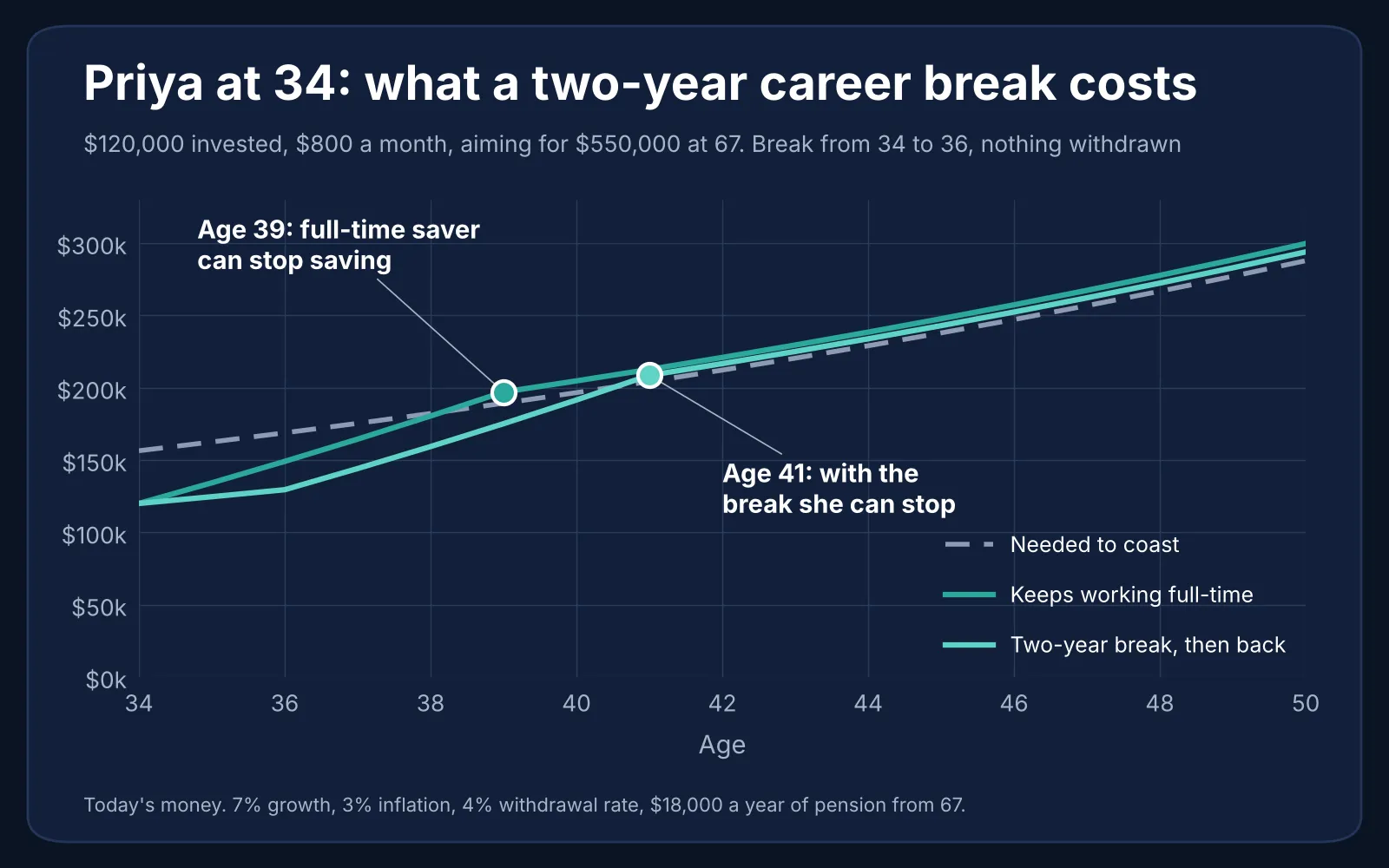
With the break (light teal), her money grows slowly for two years, then meets the amount needed to coast (dashed) at 41 instead of 39.
Why the order matters: coast first, break second
If Priya can wait, there is a gentler route. She works full-time until 39, reaches Coast FIRE, and then takes her two years off.
Once she has reached Coast FIRE, she no longer needs to save for retirement at all. So a break at 39 changes nothing about her pot (a smaller state pension aside, which we come to below). It grows to about $572,661 by 67 either way, more than the $550,000 she needs.
This is the big idea behind a career break with Coast FIRE: reach your number first, and your time off stops costing your future self anything. You only need enough money to cover your living costs during the break. If you have reached it already, what to do after Coast FIRE walks through how to test your margin first.
Scenario 2: Coast FIRE with part-time work
Part-time work is the other common choice. Fewer hours often means less pay, so less to save.
Say Priya goes to a three-day week and can save only $300 a month instead of $800. She now reaches Coast FIRE at 48 instead of 39. That is nine years later, but she gets those years with two extra days off every week.
What if she saved nothing at all from now on? Then she would never reach Coast FIRE before 67. Her pot would grow to about $421,908, which is about $128,092 short of what she needs.

So with part-time work, small saving matters a lot. $300 a month gets Priya there. $0 does not. If you plan to work part-time for good and let your pay cover your bills, that is closer to Barista FIRE. The Barista FIRE calculator shows how that works, and Coast FIRE vs Barista FIRE vs Fat FIRE compares the paths.
The hidden costs of a career break
Three things can make a break cost much more than the two years above.
1. Spending your investments. Say Priya uses $20,000 of her retirement money to pay for her break. At 36 she would have about $107,918 and be only 63.9% of the way there. She would reach Coast FIRE at 44, not 41. Taking $20,000 out cost her three extra years on top of the break itself. Withdrawals from retirement accounts can also bring taxes or penalties, depending on your country and account type.
2. A smaller state pension. Many state pensions depend on how many years you work.
- In the US, Social Security uses your highest 35 years of earnings, and counts a zero for each year with no earnings. So a year off can lower your benefit, especially if you have fewer than 35 years of earnings.
- In the UK, you usually need 35 qualifying years for the full new State Pension. You may get National Insurance credits during a break, for example if you are claiming Child Benefit for a child under 12 or caring for someone. You can also often pay voluntary contributions to fill gaps.
If Priya’s break lowered her pension by $1,000 a year, the pot she needs would rise to $575,000, and she would reach Coast FIRE at 42 instead of 41. Every $1,000 a year of lost pension means $25,000 more pot at a 4% withdrawal rate. Coast FIRE with a pension shows how to count yours safely.
3. Losing an employer’s matching contribution. If your employer adds money when you save, that stops when you stop working. It is worth checking your own plan’s rules before you go.
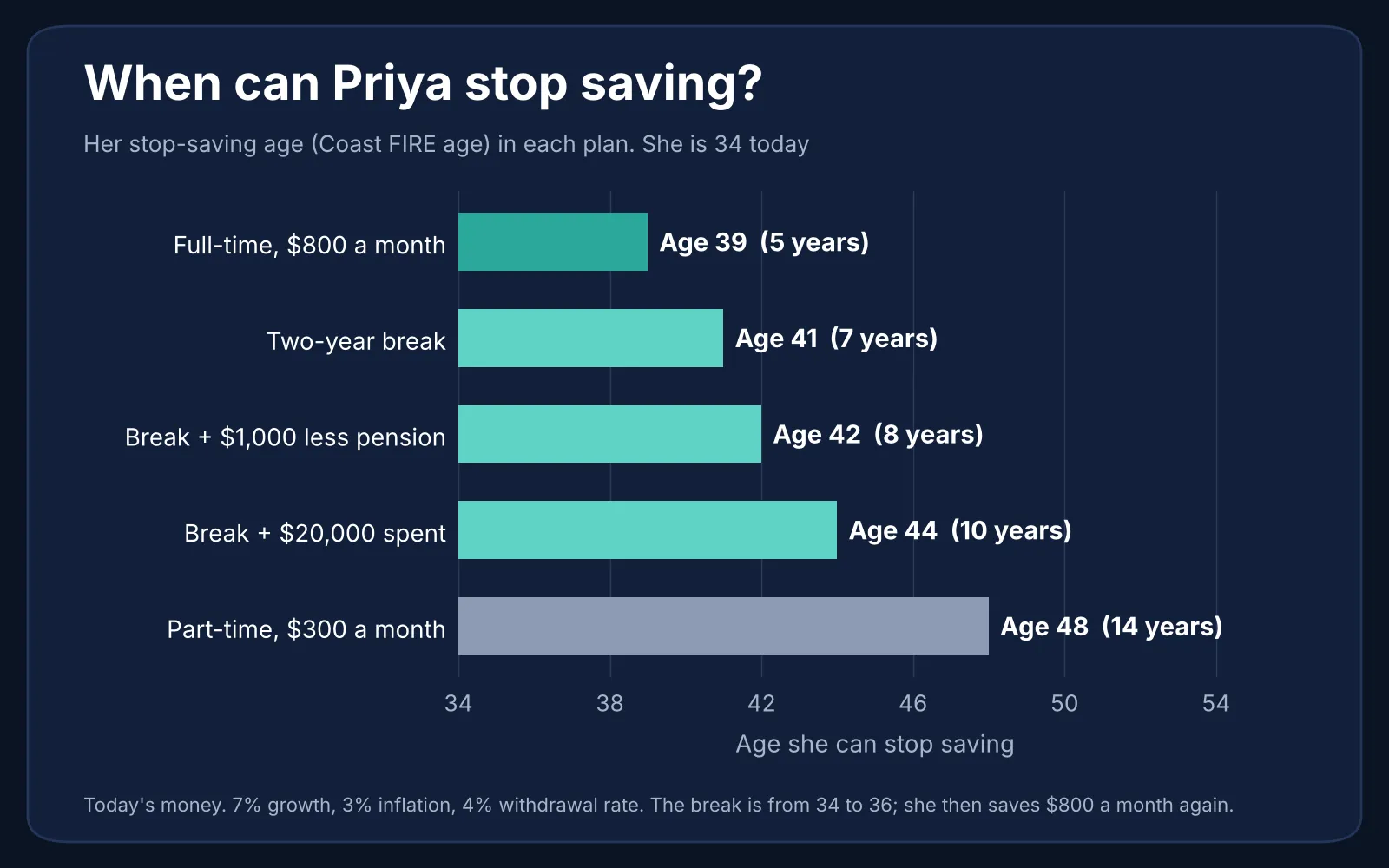
Leaving the investments untouched keeps the cost of a break small. Spending them or saving very little costs much more.
| Priya’s plan | Age she can stop saving | Delay vs full-time |
|---|---|---|
| Full-time, $800 a month | 39 | none |
| Two-year break, then $800 a month | 41 | 2 years |
| Break, and $1,000 a year less pension | 42 | 3 years |
| Break, and $20,000 taken from investments | 44 | 5 years |
| Part-time, $300 a month | 48 | 9 years |
How to plan your own career break or part-time switch
You can do this today in about ten minutes:
- Find your Coast FIRE number and age now. Enter your real figures in the calculator and write down your stop-saving age.
- Test the break. Work out what your money will have grown to when the break ends: multiply it by 1.0388 for each year off (Priya: $120,000 × 1.0388 × 1.0388 = about $129,500). Then enter that amount in the calculator as your investments, with your age when the break ends and your normal saving. The change in your stop-saving age is the cost of your break.
- Test part-time. Put in the smaller amount you could save on reduced hours and see how far your stop-saving age moves.
- Build a separate break fund. Work out your living costs for the break and save them outside your retirement money, so you do not need to touch your investments.
- Check your pension record. Look at your Social Security Statement in the US or check your National Insurance record in the UK, and see whether a break would leave a gap.
- If you can, coast first. Even a year or two more of saving before a break can move you much closer to your number.
Coast FIRE, part-time work and career breaks: questions people ask
Can I take a career break and still retire on time? Often, yes. In Priya’s case a two-year break delays the age she can stop saving, but not her retirement age of 67. What matters is whether you reach your Coast FIRE number at some point before you retire.
Is it better to take a break before or after Coast FIRE? After, if you can. Once you have reached your number, a break does not change your retirement pot. Before it, a break pushes your stop-saving age back.
Is part-time work the same as Coast FIRE? Not quite. Coast FIRE is about your retirement pot: once you reach it, you only need to earn enough to cover today. Many people then choose part-time work. Going part-time before you reach it just means saving more slowly.
Every setting is explained on the methodology page.
Work out your own number
A career break or fewer hours does not have to wreck your retirement plans. Leave your investments alone, keep an eye on your pension record, and if you can, reach your Coast FIRE number first.
Find your Coast FIRE number. It works for singles and couples, includes pensions, and shows every step of the maths with your own figures.
This article is for education, not financial advice. All figures are in today’s money and do not include taxes or fees.
What is your Coast FIRE number?
Find the age you can stop saving for retirement. Free, no sign-up, and your numbers stay on your device.
Find your own Coast FIRE numberPhotos: Uriel Mont, Gustavo Fring on Unsplash.