How a 1% investment fee changes your Coast FIRE number
By Gourav Boruah · November 3, 2026 · 9 min read

A 1% investment fee comes straight off your growth every year. On a Coast FIRE plan, that pushes up the amount you need today by about a third and can add 10 years or more to the time you must keep saving. The fix is simple: find your total yearly fee, take it off the growth rate in the calculator, and see your real stop-saving age.
Want your own number first? Use the Coast FIRE calculator. It takes a minute and nothing is sent anywhere.
New here? What is Coast FIRE explains the idea. In short: Coast FIRE is the point where the money you already have can grow into your full retirement pot on its own, so you can stop saving for retirement.
The quiet problem a fee creates
You do everything right. You save every month. You do not touch the money. But a few worries never quite go away:
- “Am I even paying a fee?” It rarely shows up as a bill. It is taken quietly from inside your fund or account.
- “1% sounds tiny. Does it matter?” It feels like rounding. It is not.
- “Why is my money growing slower than I expected?” Fees are one common reason.
- “When can I actually stop saving?” Without the fee in your sums, your answer may be years too early.
This post turns that vague worry into one clear number: the age you can stop saving, with your fee included.
What counts as an investment fee?
The US regulator’s bulletin on fees and expenses sorts them into fees you pay when you buy or sell, and ongoing fees you pay every year. For Coast FIRE, the ongoing ones matter most, because they repeat for decades:
- The fund’s yearly charge. Called the expense ratio in the US and the ongoing charge (OCF) in the UK. It is a percentage of your money, taken every year.
- An adviser’s fee. Many financial advisers (advisors, in the US) charge a yearly percentage of what they manage for you, such as 1%. This is sometimes called an AUM fee (assets under management).
- Platform or plan fees. The app, broker or workplace plan that holds your funds may add its own yearly charge.
Add them together. That total is your real fee. A 0.2% fund inside a 0.3% platform with a 1% adviser is a 1.5% yearly fee.
Why a 1% investment fee is bigger than it sounds
A fee is not 1% of your growth. It is 1% of your whole balance, every year. If your money grows 7% in a year and you pay 1%, you keep about 6%. One seventh of your growth is gone.
Now take inflation out too, as the calculator does. Why 7% growth is not really 7% explains this step in full.
- With almost no fee (0.1%): (1 + 0.069) ÷ (1 + 0.03) − 1 = 3.79% real growth a year.
- With a 1% fee: (1 + 0.06) ÷ (1 + 0.03) − 1 = 2.91% real growth a year.
So a 1% fee takes away close to a quarter of your real growth. People call this fee drag, and over 30 years it compounds into a big gap.
The SEC shows the same effect with its own example: $100,000 growing 4% a year for 20 years ends at about $208,000 with a 0.25% fee, but only about $179,000 with a 1% fee.
A worked example: Leo at 35
Meet Leo. He is 35 and has $60,000 invested for retirement. He adds $700 a month. He wants to retire at 67, expects to spend $45,000 a year, and expects a pension (or Social Security) of about $22,000 a year.
We use the calculator’s defaults: 7% growth, 3% inflation and a 4% withdrawal rate. Then we take his fee off the growth.
Step 1: The pot he needs at 67. ($45,000 − $22,000) ÷ 0.04 = $575,000. Fees do not change this. The 4% rule explained shows where the 0.04 comes from.
Step 2: Real growth after his fee. Low-cost fund at 0.1%: growth is 6.9%, so real growth is 3.79%. With a 1% fee: growth is 6%, so real growth is 2.91%.
Step 3: How much $1 grows to in 32 years. At 3.79%: about 3.285. At 2.91%: about 2.506.
Step 4: His Coast FIRE number today. At a 0.1% fee: $575,000 ÷ 3.285 = about $175,054. At a 1% fee: $575,000 ÷ 2.506 = about $229,441.
The 1% fee makes the number he needs today $54,387 higher, about 31% more. His $60,000 is 34.3% of the way there with a low fee, but only 26.2% with a 1% fee.
Step 5: When he can stop saving. With the low fee, Leo’s money passes the amount he needs at 55. He has about $370,836 by then, just above the $368,114 he needs at that age. From 55, he can stop saving for retirement.
With a 1% fee, he does not get there until 66, one year before he retires. Same saving, same goal. The fee alone costs him 11 more years of putting in $700 a month.
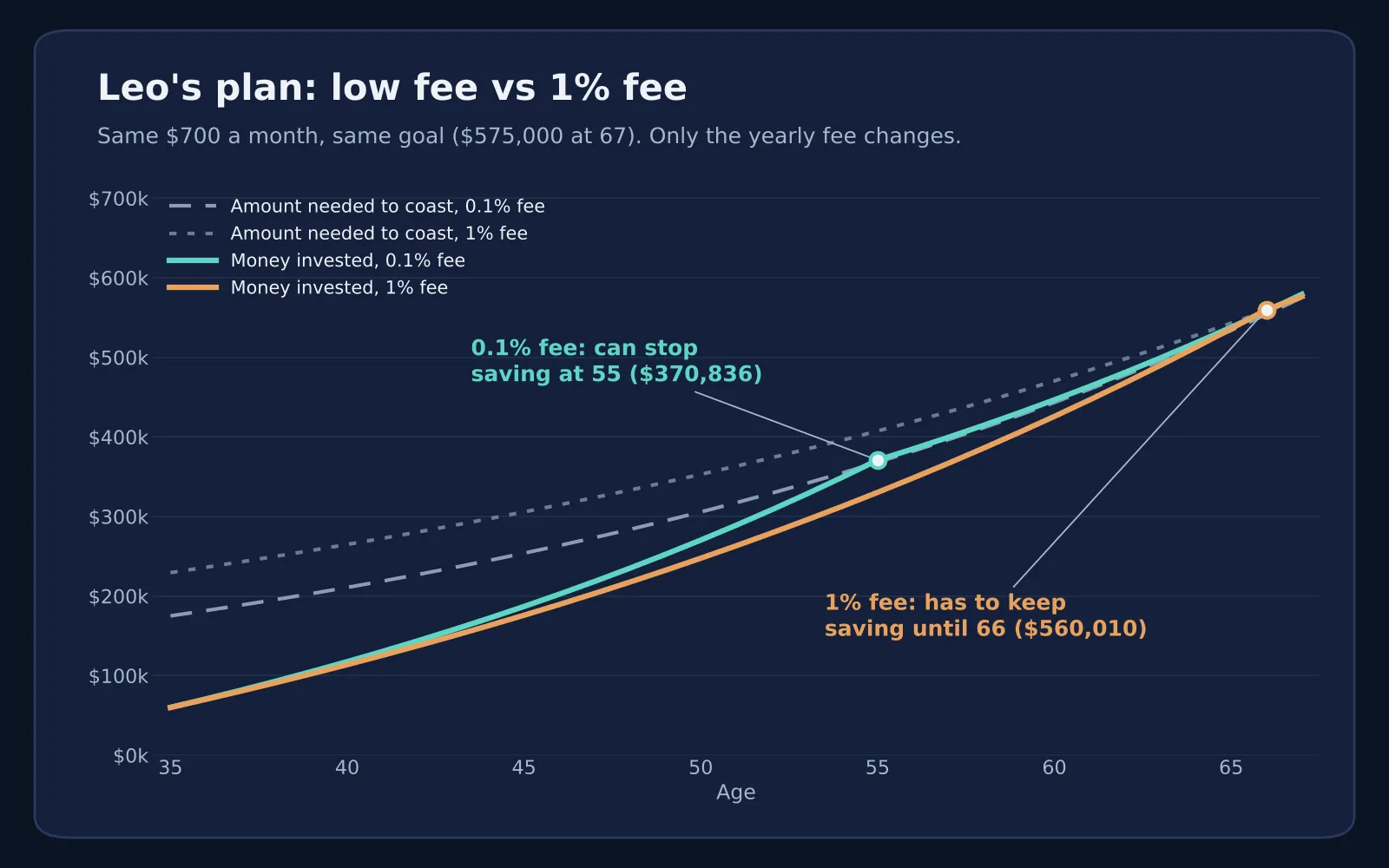
Both lines start at $60,000. The fee decides whether Leo coasts from 55 or saves almost to the end.
What different fees do to the same plan
We ran Leo’s plan again at four fee levels, changing nothing else.
| Leo’s total yearly fee | Growth after fee | Coast FIRE number at 35 | Age he can stop saving |
|---|---|---|---|
| 0.1% | 6.9% | $175,054 | 55 |
| 0.5% | 6.5% | $197,366 | 60 |
| 1% | 6% | $229,441 | 66 |
| 1.5% | 5.5% | $266,920 | Never: about $528,701 at 67, short of $575,000 |
Every extra half point of fee costs him roughly five or six more years of saving. At 1.5%, he saves every month until 67 and still ends up about $46,299 short.
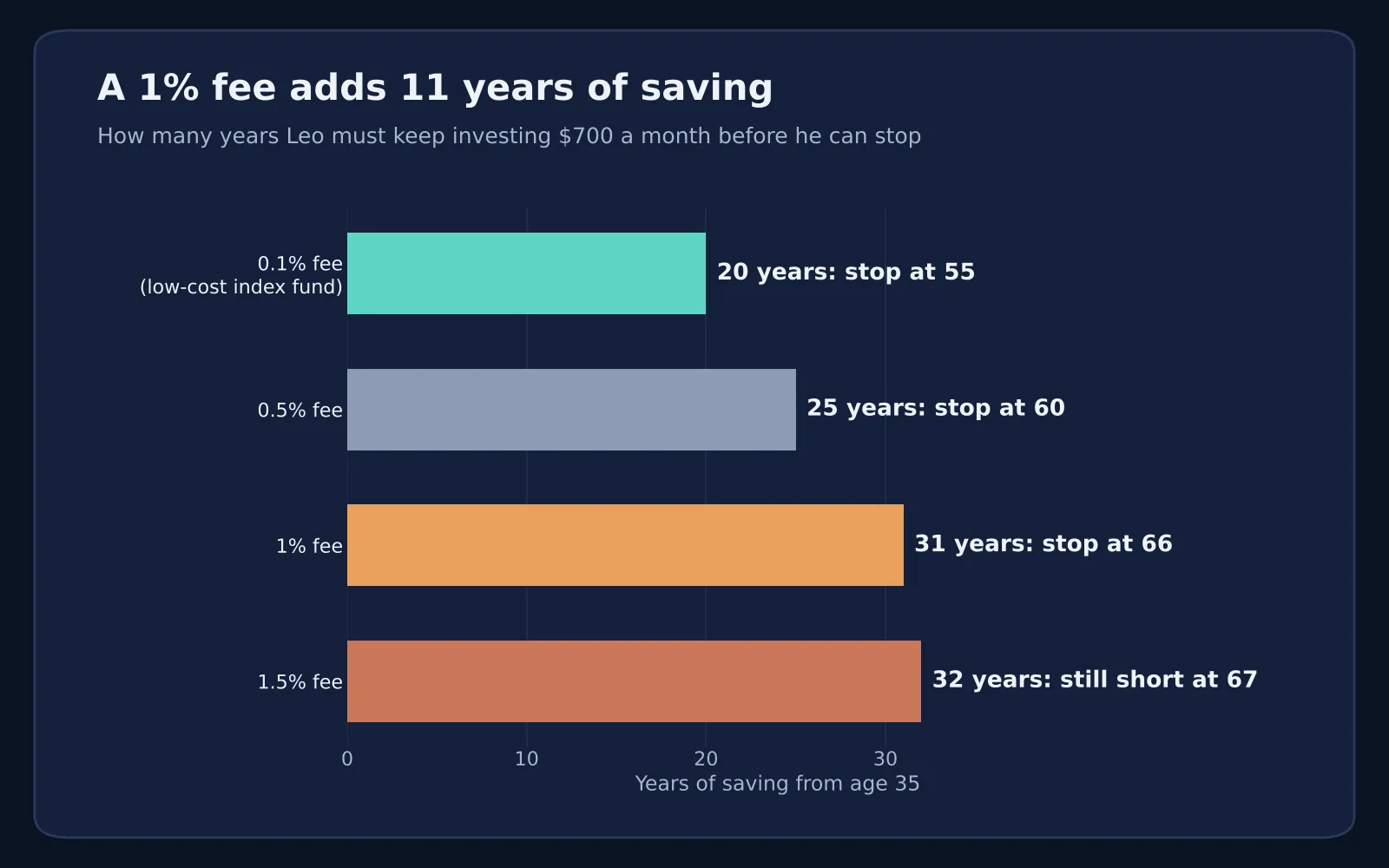
Same saver, same goal. Only the fee changes.
Here is another way to see it. If Leo left his $60,000 alone for 32 years, it would grow to about $197,082 in today’s money with a 0.1% fee, but only about $150,365 with a 1% fee. The fee eats almost a quarter of what his first $60,000 could become.
And if Leo keeps the 1% fee but still wants to stop at 55, the calculator says he would need to save about $950 a month instead of $700. That is an extra $250 a month, every month, for 20 years, just to make up for the fee.

How to put your fee into the calculator
The calculator does not have a separate fee box. You add your fee by lowering the growth rate. It takes under a minute:
- Open the calculator and fill in your age, savings, monthly saving, spending and pension as usual.
- Find the line that reads Growth 7% · Inflation 3% · Withdrawal 4% and tap Change.
- In Yearly growth, before inflation (%), take your total fee off 7%. A 1% fee means typing 6. A 0.25% fee means 6.75.
- Look at your stop-saving age. That is your honest number.
- Now try it with a lower fee. The gap between the two ages is what your fee is costing you in years.
This is a close estimate, not an exact one, because real fees are taken in small amounts through the year. The methodology page explains how the calculator works.
Find your real total fee this week
This is general education, not advice for your situation. Rules and products differ by country.
- List every account you hold for retirement. Workplace plan, personal pension, ISA, IRA, brokerage account.
- Find each fund’s yearly charge. Look for “expense ratio”, “ongoing charge” or “OCF” on the fund’s fact sheet or your account page. In the US, FINRA’s free Fund Analyzer lets you look up and compare fund costs.
- Find the account or platform fee. Check your provider’s price list or yearly statement.
- Ask your adviser, in writing, for their total yearly fee as a percentage. The SEC’s bulletin encourages investors to ask about every fee and check statements.
- Add them up. That is the number you take off the growth rate.
- Compare it with typical costs. The Investment Company Institute reports that in 2025 the average yearly charge was 0.40% for equity mutual funds and 0.14% for index equity ETFs (averages weighted by money invested). If your total is far above these, it is worth a closer look.
Low-cost index funds are one common way people keep fees down. Index funds in plain English explains how they work.
Is a 1% adviser fee ever worth it?
Sometimes, for some people. A good adviser can help with tax, pensions, insurance, wills, and, most of all, with not selling in a panic when markets fall. Those things have real value, and some people would never invest at all without help.
But be clear about the price. In Leo’s case, a 1% yearly fee costs him about 11 years of saving. Questions worth asking:
- What exactly do I get for the fee each year?
- Is there a flat-fee or hourly option instead of a percentage? Some advisers offer one-off plans for a fixed price.
- Does the fee drop as my balance grows? A percentage fee costs more in money every year your pot grows, even if the work stays the same.
There is no single right answer. The calculator simply shows you the trade, in years, so you can decide with clear eyes.

Investment fees: questions people ask
How much does a 1% fee cost over 30 years? It depends on your growth, but it compounds. In Leo’s example, $60,000 left alone for 32 years ends up about $46,717 smaller in today’s money with a 1% fee than with a 0.1% fee.
Is a 0.5% fee high? It is above the 2025 averages the ICI reports for equity funds and index ETFs. In Leo’s plan, 0.5% instead of 0.1% moves his stop-saving age from 55 to 60.
Do fees change my retirement target? No. Your target pot depends on your spending, pension and withdrawal rate. Fees change how fast you get there, so they change your Coast FIRE number today and your stop-saving age.
What if we are a couple? Use your combined investments, saving and the average fee across your accounts. Coast FIRE for couples shows how.
Work out your own number
You cannot control the market. You can control what you pay. Finding your fee takes an evening, and it may be the single change that brings your stop-saving age closest.
Find your Coast FIRE number. It works for singles and couples, includes pensions, and shows every step of the maths with your own figures. Run it once with your current fee taken off the growth rate, then once with a lower fee, and see how many years apart the two answers are.
This article is for education, not financial advice. All figures are in today’s money and do not include taxes or fees.
What is your Coast FIRE number?
Find the age you can stop saving for retirement. Free, no sign-up, and your numbers stay on your device.
Find your own Coast FIRE numberPhotos: cottonbro studio, Andrea Piacquadio, SHVETS production on Unsplash.