Coast FIRE on one income: how a single-income household gets there
By Gourav Boruah · November 6, 2026 · 9 min read

Yes, you can reach Coast FIRE on one income. The trick is to plan as one household: count every pound or dollar you have invested together, and count the pension the partner at home will still get. In our example below, a family living on one salary can stop saving for retirement at 46.
Want your own number first? Use the Coast FIRE calculator. It takes a minute and nothing is sent anywhere.
New here? What is Coast FIRE explains the idea. In short: Coast FIRE is the point where the money you already have can grow into your full retirement pot on its own, so you can stop saving for retirement.
The worry of living on one income
Maybe one of you stopped work to look after the children. Maybe one of you is caring for a parent, studying, or simply between jobs. Whatever the reason, the same worries tend to show up:
- “We are falling behind.” Friends with two salaries seem to save twice as much.
- “One pay cheque has to fund two retirements.” That feels like a lot to ask of one person’s job.
- “The partner at home is building nothing.” No salary, so no pension, so no future. Or so it seems.
- “We have no idea if we are on track.” So you either over-save and feel squeezed, or avoid looking at all.
This post replaces those worries with one clear answer: the age your household can stop saving for retirement, on the income you have now.
Why one income is not as far behind as it feels
Three things work in your favour.
- Your goal is shared, not doubled. A couple does not need two separate retirement pots. You need one pot big enough to cover the spending your household’s pensions do not. Coast FIRE for couples shows how to add everything together.
- The partner at home may still get a pension. In the US, a husband or wife can get a Social Security benefit based on their spouse’s work record. The Social Security Administration says this spousal benefit can be as much as half of the worker’s full benefit, if it starts at full retirement age. It is lower if it starts earlier. Other countries have their own rules, so check your government’s pension pages.
- Early money does the heavy lifting. Money invested in your 30s has decades to grow. Even a modest amount saved now can carry a lot of the load.
A worked example: Jess and Marco on one salary
Meet Jess and Marco. Both are 36. Marco works; Jess stays at home with their two children. Between them they have $70,000 invested for retirement, and on Marco’s salary they can add $700 a month.
They want to retire at 67 and expect to spend $54,000 a year in retirement. Marco’s Social Security estimate is about $24,000 a year. Jess’s spousal benefit could be up to half of that, about $12,000 a year. Together that is $36,000 a year of pension income.
We use the calculator’s defaults: 7% growth, 3% inflation and a 4% withdrawal rate.
Step 1: The pot they need at 67. Pensions cover $36,000 of their $54,000. The pot covers the rest: ($54,000 − $36,000) ÷ 0.04 = $450,000. The 4% rule explained shows where the 0.04 comes from.
Step 2: Growth after inflation. (1 + 0.07) ÷ (1 + 0.03) − 1 = 3.88% a year. Why 7% growth is not really 7% explains this step.
Step 3: How much $1 grows to in 31 years. At 3.88% a year, $1 today becomes about $3.258 by the time they are 67.
Step 4: Their Coast FIRE number today. $450,000 ÷ 3.258 = about $138,124. Their $70,000 is already 50.7% of the way there.
Step 5: When they can stop saving. Saving $700 a month, their money passes the amount they need at 46. By then they have about $202,770, just above the $202,178 they need at that age. From 46, they can stop saving for retirement and let the money grow. Left alone, it reaches about $451,317 by 67.
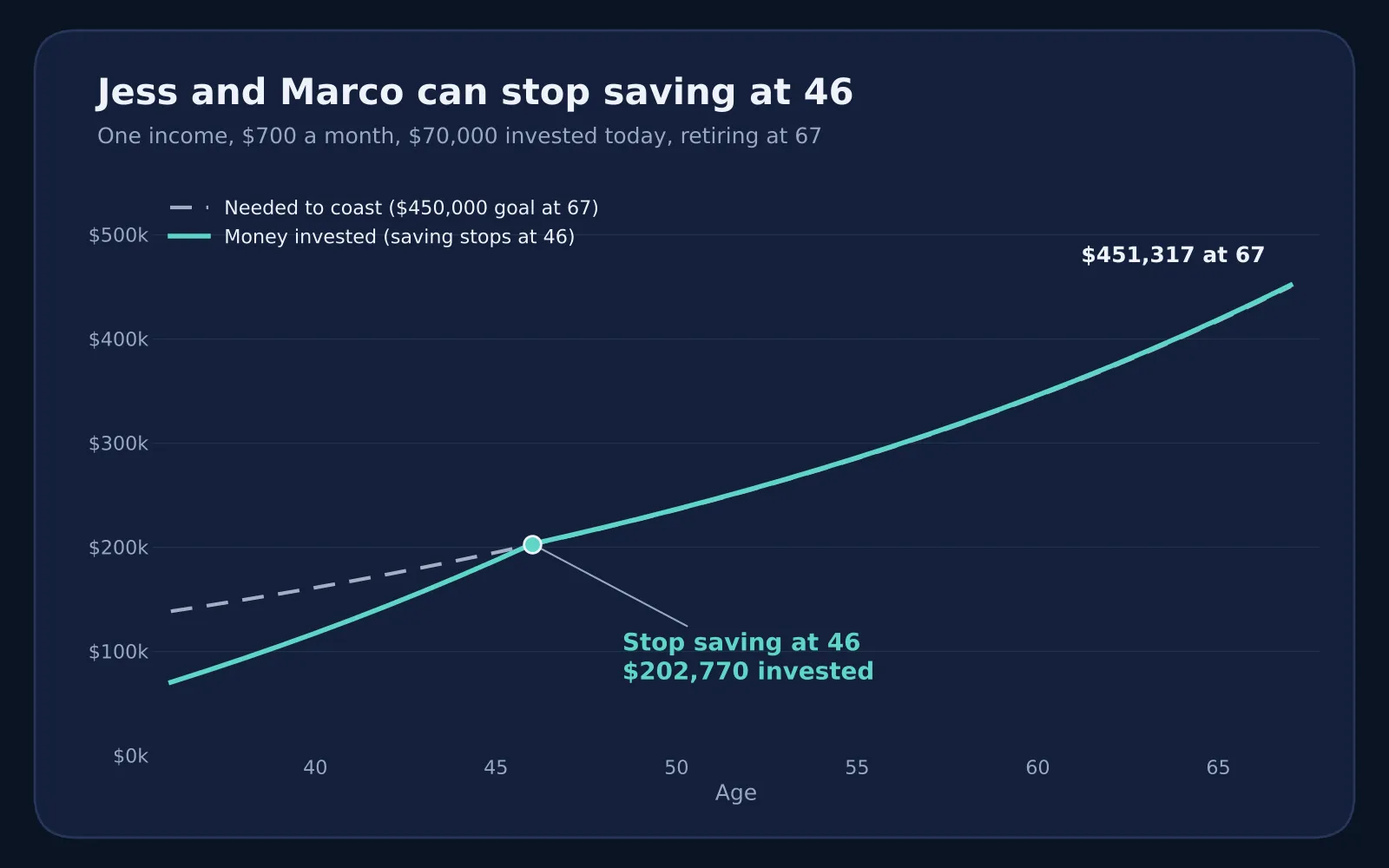
Ten years of saving on one salary, then the money does the rest.
And how far behind are they really? If Jess went back to work and they could save $1,500 a month, they would reach Coast FIRE at 41. So one income costs them about five years of extra saving. That is real, but it is not the lifetime gap it feels like.
The step that changes everything: counting the partner at home
Here is the mistake to avoid. Many single-income couples put in only the working partner’s pension, because the one at home “isn’t earning”.
If Jess and Marco leave out Jess’s spousal benefit, their pension income drops to $24,000. Their goal jumps to ($54,000 − $24,000) ÷ 0.04 = $750,000. Their Coast FIRE number today rises to about $230,207. Even saving $700 every month until 67, they would reach only about $716,448, around $33,552 short.
Same family, same money. One missing line in the sums turns “stop at 46” into “never”. Coast FIRE with a pension explains why pensions shrink your number so much.
Jess may also have her own pension record from years she worked before the children. In the US, Social Security pays the higher of the two, not both added together, so check your own statement. The amounts are estimates and rules can change, so treat them as a starting point.

What moves a one-income plan the most
We ran Jess and Marco’s plan again, changing one thing at a time.
| What changes | Their goal at 67 | Age they can stop saving |
|---|---|---|
| Saving $400 a month | $450,000 | 58 |
| Saving $700 a month (their plan) | $450,000 | 46 |
| Saving $1,000 a month | $450,000 | 43 |
| $700 a month, spending $50,000 a year in retirement | $350,000 | 41 |
| $700 a month, Jess’s benefit left out | $750,000 | Never: about $716,448 at 67 |
Two things stand out:
- Spending in retirement matters more than you might think. Planning to spend $4,000 a year less in retirement brings their date forward by 5 years. Saving $300 a month more brings it forward by 3. How to estimate what you will spend in retirement helps you get this number right.
- Cutting saving too far is costly. Dropping to $400 a month pushes their date back by 12 years, to 58.
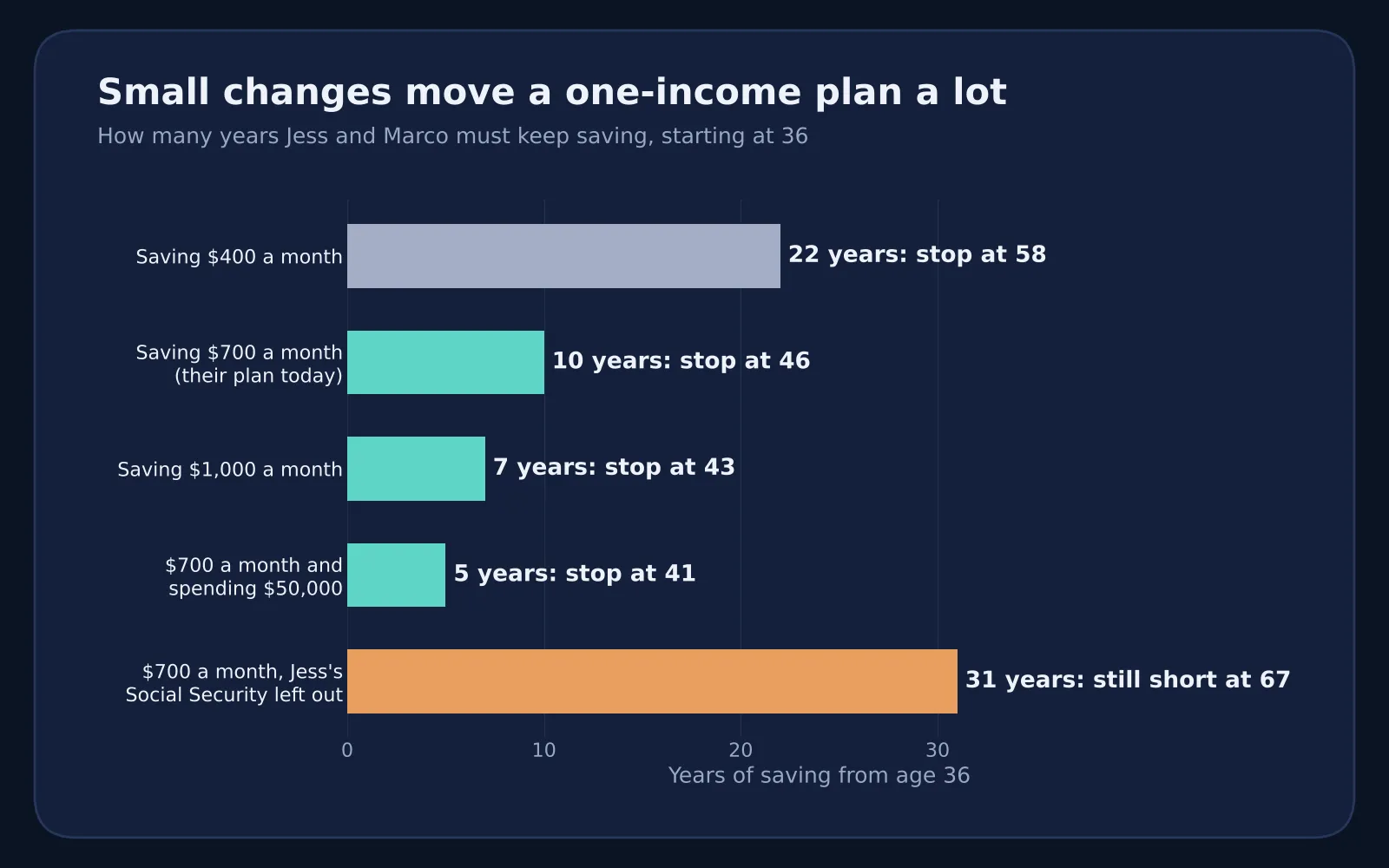
Same family, one change at a time.
Protecting a plan that rests on one job
A one-income plan has one weak spot: it depends on one person’s health and job. This is general education, not advice for your situation, but these are the questions worth looking at.
- Build an emergency fund first. With one salary, a job loss stops everything. Emergency fund first or Coast FIRE first? walks through the order.
- Think about what happens if the earner cannot work. Many families look at life cover and income protection (disability insurance) through work or on their own. What suits you depends on your family and country.
- Keep the at-home partner’s retirement savings going if you can. In the US, a spouse with little or no income can still pay into an IRA when filing a joint return, as long as the working spouse earns enough. The IRS sets the 2026 limit at $7,500, or $8,600 from age 50. In the UK, a parent registered for Child Benefit for a child under 12 gets National Insurance credits towards their State Pension, even if they do not receive the payment.
- Talk about the plan together. The person at home should know where the money is and what the number is. It is a shared plan.
If you are single, you live on one income too
Not every one-income household is a couple. If you are single, your situation is simpler in one way: one person, one pension, one goal. Put in your own savings, your own pension estimate and your own spending. The same levers apply: saving a little more, spending a little less in retirement, and making sure your pension is counted.
If full-time work becomes too much later, part-time income can cover some of your spending. The Barista FIRE calculator shows how much part-time pay you would need.
How to put a one-income household into the calculator
It takes under two minutes:
- Open the calculator and choose couple (or single, if it is just you).
- Enter everything you have invested for retirement, in both names, as one total.
- Enter what you can save each month on the one salary you have now.
- Enter your yearly spending in retirement for the whole household.
- Enter both pensions: the earner’s estimate plus the at-home partner’s own or spousal benefit.
- Look at your stop-saving age. Then try a lower spending figure and a slightly higher monthly saving to see which helps more.
The methodology page explains every step the calculator takes.

Coast FIRE on one income: questions people ask
Can a stay-at-home parent reach Coast FIRE? Yes. The plan belongs to the household, not to one salary. In our example, a family living on one income can stop saving at 46.
Should the at-home partner’s pension count? Yes, if they are likely to get one. In the US that may be their own Social Security or a spousal benefit of up to half the worker’s. Leaving it out made Jess and Marco’s goal $300,000 bigger.
Is it better to save more or spend less later? Run both. For Jess and Marco, planning to spend $4,000 a year less in retirement moved their date further than saving $300 a month more.
What if the at-home partner goes back to work later? Then your saving goes up and your date comes sooner. Update the calculator when it happens. It only takes a minute.
Work out your own number
Living on one income does not mean giving up on an early stop-saving date. It means planning as a team and counting everything you have.
Find your Coast FIRE number. It works for singles and couples, includes pensions, and shows every step of the maths with your own figures. Enter both partners’ pensions, then try one small change at a time and see which brings your date closest.
This article is for education, not financial advice. All figures are in today’s money and do not include taxes or fees.
What is your Coast FIRE number?
Find the age you can stop saving for retirement. Free, no sign-up, and your numbers stay on your device.
Find your own Coast FIRE numberPhotos: Vlada Karpovich, Mikhail Nilov, Gustavo Fring on Unsplash.