Coast FIRE in Australia: super and the Age Pension
By Gourav Boruah · October 23, 2026 · 10 min read

Coast FIRE in Australia works the same way as anywhere else: once your super and other investments can grow into your full retirement pot on their own, you can stop putting in extra for retirement. Two things make Australia different. The Age Pension can cut your Coast FIRE number by more than two thirds, but it is means-tested, so you have to count it with care. And your employer keeps paying into your super while you work, even after you “coast”.
Want your own number first? Use the Coast FIRE calculator. It takes a minute and nothing is sent anywhere.
If “Coast FIRE” is new to you, start with what Coast FIRE is. All amounts in this article are in Australian dollars.
The Age Pension: a big help, with conditions
The Age Pension is paid by the government from age 67. To get it, you normally need to have been an Australian resident for at least 10 years, and your income and assets must be under certain limits, as my.gov.au explains.
From 20 September 2026 to 19 March 2027, the maximum rate is $1,237.70 a fortnight for a single person and $933.00 a fortnight each for a couple, including supplements, according to the Department of Social Services. Over a year (26 fortnights) that comes to:
- Single: $1,237.70 × 26 = $32,180.20 a year.
- Couple: $933.00 × 2 × 26 = $48,516 a year.
Why this matters so much: at a 4% withdrawal rate, every $1 of yearly pension saves you $25 in the pot. A full couple’s pension does the work of about $1,212,900 of savings ($48,516 × 25).
The catch: the more you have, the less you get
Unlike a work pension, the Age Pension shrinks as your assets and income grow. Two tests decide how much you get, and the one that gives you the lower amount is the one that counts:
- The assets test. From 1 July 2026, a homeowner couple can have up to $499,000 of assets (not counting the home itself) and still get the full pension. For a single homeowner it is $333,000, according to the Department of Social Services. Above that, the pension gets smaller, and it stops altogether at a bit over $1 million for a homeowner couple. Non-homeowners have higher limits. Services Australia lists the limits for each situation.
- The income test. Earnings and a set “deemed” income on your savings can reduce the pension too.
So here is the simple check for a Coast FIRE plan: if the pot you need is well under the full-pension limit, counting the full Age Pension is reasonable. If it is far above, count much less, or none. The bigger the pot, the less pension you will get.

A worked example: Jess and Liam at 30
Meet Jess and Liam. They are both 30, live in Brisbane and expect to own their home by retirement. Between them they have $50,000 in super. Each month $1,800 goes in: $1,400 from their employers’ compulsory super and $400 of their own salary sacrifice.
They want to spend $68,000 a year in retirement, in today’s money. They plan to retire at 67, when the Age Pension starts, and they count the full couple’s pension of $48,516 a year.
They use the calculator’s defaults: 7% growth, 3% inflation and a 4% withdrawal rate.
Step 1: The pot they need at 67. ($68,000 − $48,516) ÷ 0.04 = $487,100.
That is under the $499,000 full-pension limit for a homeowner couple, so counting the full pension passes the check, just.
Step 2: Real growth. (1 + 0.07) ÷ (1 + 0.03) − 1 = 3.88% a year. That is how much faster their money grows than prices.
Step 3: How much $1 grows to in 37 years. 1.0388 to the power of 37 = about 4.09. Every dollar they have today becomes about $4.09 by 67, in today’s money.
Step 4: Their Coast FIRE number today. $487,100 ÷ 4.09 = about $119,000 (the calculator’s exact figure is $118,958.55).
With $50,000 in super, they are already 42% of the way there. If they keep putting in $1,800 a month, they catch up at 34, with $149,795.84 invested. After that, growth alone takes their money to about $526,666.88 by 67.
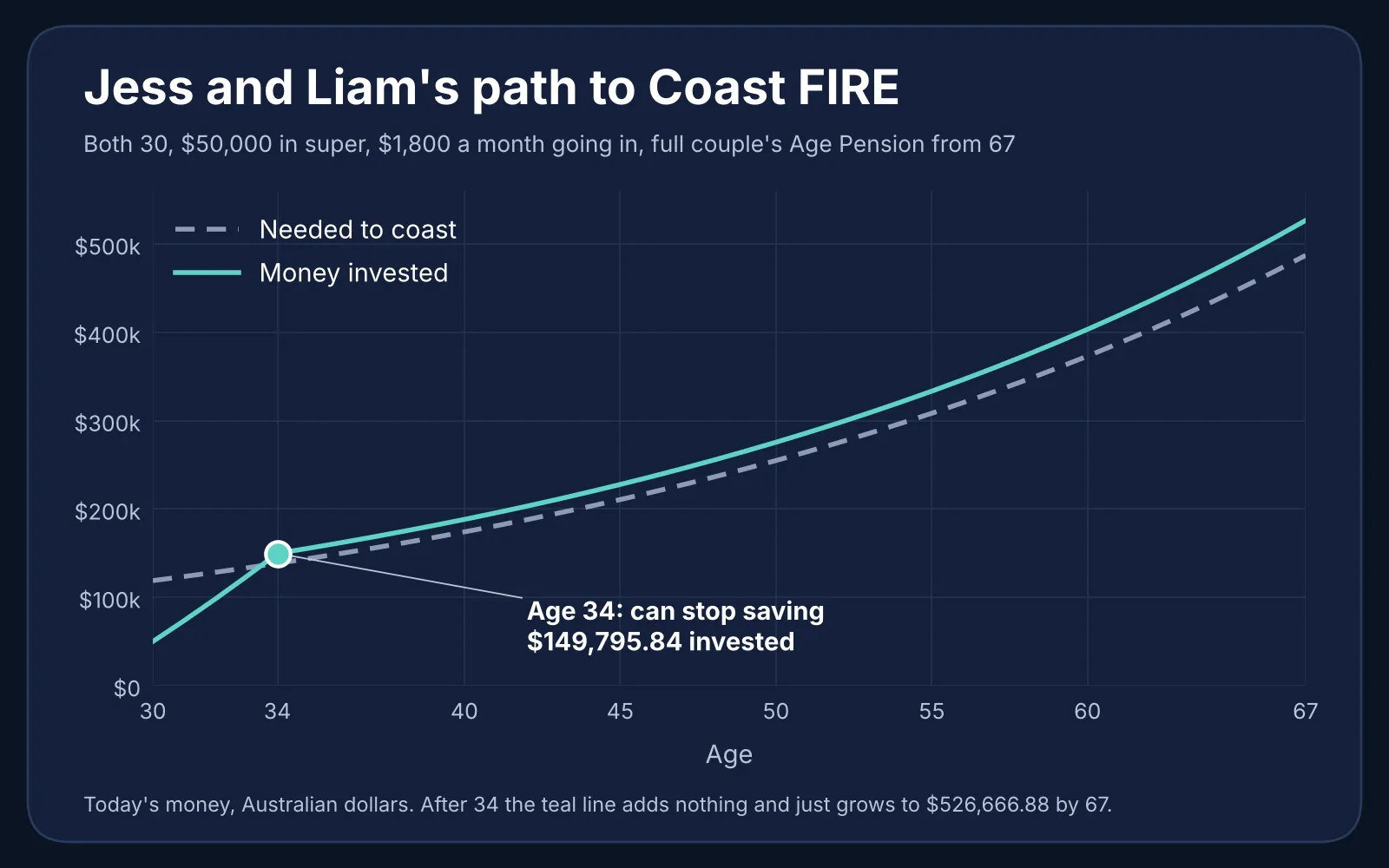
Their money invested (teal) meets the amount needed to coast (dashed) at 34. From then on, growth does the rest.
What “stop saving” means in Australia
Here is the Australian twist. If Jess and Liam stay in paid work, their employers must keep paying super for them. So “coasting” does not mean their super stops growing from new money. It means:
- They can stop the extra $400 a month of salary sacrifice and spend it now.
- They could work less, take a career break or change to lower-paid work they enjoy, knowing the plan no longer depends on their pay.
- Any compulsory super still paid in is a safety margin, not a requirement.
One thing to keep in mind: a much bigger pot at 67 can mean a smaller Age Pension. Extra super is never wasted, but each extra dollar does less than you might think once you pass the full-pension limit.
What if they count the Age Pension differently?
Now the same couple, with everything else unchanged, but different pensions counted.
| Pension counted | Pot needed at 67 | Coast FIRE number today | They can stop saving at |
|---|---|---|---|
| Full couple’s Age Pension ($48,516 a year) | $487,100 | $118,958.55 | 34 |
| Half the full pension ($24,258 a year) | $1,093,550 | $267,064.51 | 43 |
| No Age Pension | $1,700,000 | $415,170.48 | 59 |
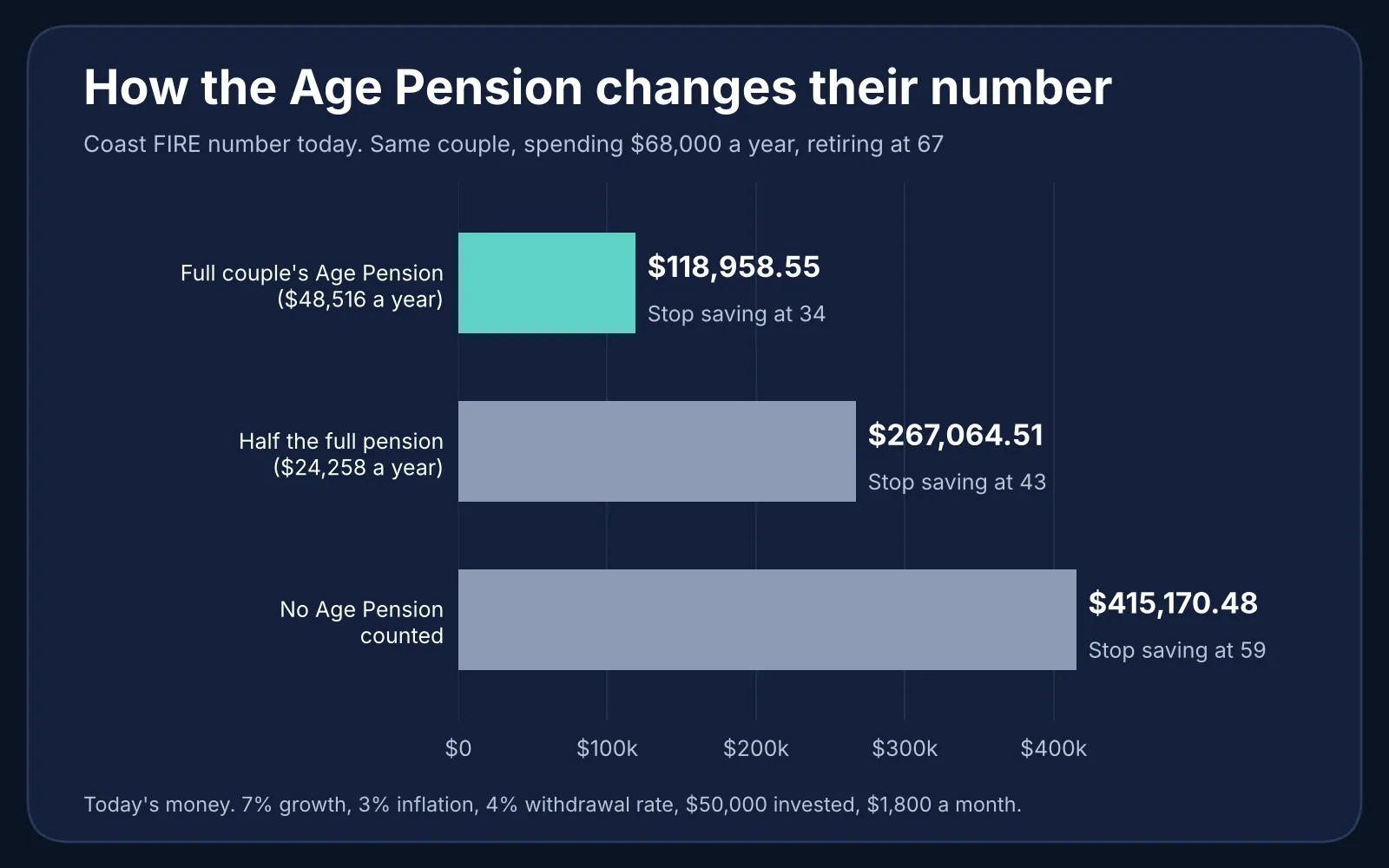
The pension you count changes everything. Check that your pot fits the pension you count.
Two things stand out:
- The half-pension row fails its own check. A pot of $1,093,550 is above the point where a homeowner couple’s pension stops, so in real life they might get little or no Age Pension at the start. That row is really closer to “no pension” than it looks. This is the trap of the means test: the more you need to save, the less the pension helps.
- Leaving the pension out is the safest plan, but a hard one. It pushes their stop-saving age from 34 to 59.
The honest answer depends on your spending. If you plan a modest retirement in a home you own, the Age Pension may carry a large share of it. If you plan to spend a lot more, count it as a small bonus. Coast FIRE with a pension shows how to count a pension safely.
Two more checks they can run:
- A careful withdrawal rate. At 3.5% instead of 4%, they would need $556,685.71 at 67, their Coast FIRE number would be $135,952.63, and they could stop saving at 35 instead of 34. Note that this pot is now above the full-pension limit, so their pension would be a little lower too. The 4% rule explained shows why some people prefer 3.5%.
- Compulsory super only. With just the $1,400 a month from their employers, they would stop at 35.

Super: what counts as “money invested”
The calculator has one box for money invested and one for monthly saving. Here is how Australian money fits in.
- Super. Count your whole balance, and your partner’s if you plan together. Employers must pay 12% of your ordinary earnings into super, a rate that has applied since 1 July 2025, as the ATO explains. Put that in your monthly saving.
- Extra super. Salary sacrifice and other before-tax payments count towards the concessional cap, which is $32,500 for 2026–27. After-tax payments count towards a separate cap of $130,000, according to the ATO. Your employer’s payments count towards the concessional cap too.
- Shares, ETFs and savings outside super. Count what is meant for retirement, not your emergency fund.
- A defined benefit pension. This pays a set income, so it goes in the pension box, not in money invested.
- Your home. Leave it out of money invested. You still need somewhere to live, and it is not counted in the Age Pension assets test either.
When can you reach the money?
For Coast FIRE the question is not just how much, but when you can use it.
- Super is locked until your preservation age, which is 60 for anyone born after 30 June 1964, according to the ATO. You can generally take it once you reach that age and retire, or once you turn 65, even if you still work, as the ATO explains.
- The Age Pension cannot start before 67.
- Money outside super can be used at any time.
So if you want to stop work before 67, you need to cover the gap. From 60 you can live on super, but between 60 and 67 you have no Age Pension, so you draw more. If you stop before 60, you need money outside super for those “bridge” years. The calculator assumes your pension starts the day you retire. If you plan to retire before 67, lower the pension figure to stay safe, or set your retirement age to 67, as Jess and Liam did.
Tax and inflation: two notes for Australia
Tax. Money taken from super after 60 is often tax-free, and the Age Pension is taxable income, although many retirees pay little or no tax on it. Money outside super is taxed as you go. The calculator works before tax, so if much of your money sits outside super, add a little to your yearly spending to cover tax.
Inflation. The Reserve Bank of Australia aims to keep inflation between 2% and 3% on average over time, as the RBA explains. The calculator’s 3% default sits at the top of that range, which is on the careful side. What really matters is the gap between growth and inflation, not either figure alone. Why 7% growth is not really 7% explains this.
Coast FIRE in Australia: questions people often ask
Should I count the Age Pension at all? If your planned spending is modest and you will own your home, it is reasonable to count it, as long as the pot you need passes the full-pension check above. If your pot will be large, count part of it or none. Rules and rates can change, so many people count a little less than today’s figures.
I moved to Australia as an adult. Can I still get it? You normally need at least 10 years as an Australian resident. Check your own case with Services Australia before you count it.
We are a couple. How do we enter it? Put both super balances in money invested, both sets of payments in monthly saving and the couple’s pension in the pension box. Coast FIRE for couples shows how to plan together, including different ages.
I’ve hit Coast FIRE but my employer still pays super. Is that a problem? No. It is extra safety. You can stop putting in extra, and the compulsory super simply builds a bigger margin.
Does super growth match the calculator’s 7%? Nobody knows future returns. Super funds take fees and tax on earnings, so you may want to test a lower growth rate, such as 6%, to see how much your stop-saving age moves.
Five steps to work out yours today
- Log in to your super fund, or to the ATO through myGov, and add up every super balance you have.
- Work out what goes in each month: your employer’s 12% plus any extra you add.
- Decide on your yearly spending in retirement, in today’s money, and whether you will own your home.
- Open the calculator, choose Australia, and enter your figures with the Age Pension you expect in the pension box.
- Check that the pot you need fits the pension you counted. Then run it again with no pension and at a 3.5% withdrawal rate. If the stop-saving ages are close, your plan is sturdy.
Every setting is explained on the methodology page.
Work out your own number
Your number depends on your spending, how much Age Pension you can fairly count, any work pension, and the gap between growth and inflation you choose. Seeing two or three versions side by side tells you more than any single answer.
Find your Coast FIRE number. It works for singles and couples, includes pensions, and shows every step of the maths with your own figures in dollars.
This article is for education, not financial advice. All figures are in today’s money and do not include taxes or fees.
What is your Coast FIRE number?
Find the age you can stop saving for retirement. Free, no sign-up, and your numbers stay on your device.
Find your own Coast FIRE numberPhotos: Joeyy Lee, Henrique Felix, Matt Bennett on Unsplash.