Does home equity count towards Coast FIRE? Your home, in plain numbers
By Gourav Boruah · October 30, 2026 · 10 min read

Does home equity count towards Coast FIRE? Usually not as invested money. The home you live in does not pay you an income, so its value should stay out of the “invested” box in a Coast FIRE calculator. But your home still matters a lot: a home that is paid off by retirement lowers what you need to spend each year, and money you plan to free up by moving somewhere smaller can count too, if you are careful with it.
Want your own number first? Use the Coast FIRE calculator. It takes a minute and nothing is sent anywhere.
New to the idea? What is Coast FIRE covers the basics. In short: Coast FIRE is the point where the money you already have can grow into your full retirement pot on its own, without any more saving.
Why your home is not “invested” money
Home equity is the part of your home you own outright: its value minus what is left on the mortgage. It is real wealth. So why leave it out?
Because Coast FIRE is about income. Your retirement pot has one job: to pay you a little each year, say 4%, for the rest of your life. Money in an index fund can do that. You can sell a small slice every year.
You cannot sell one bedroom of the house you live in. Your home only turns into spending money if you do something big:
- Sell it and move somewhere cheaper (downsizing).
- Sell it and rent for the rest of your life.
- Borrow against it, for example with a reverse mortgage or equity release.
If you do not plan to do any of those, your home is where you live, not something that pays your bills. Counting it as invested money makes your plan look far better than it is.
So the home counts in two other ways instead, and both are easy to put into the calculator:
| How your home can count | Which box in the calculator |
|---|---|
| A paid-off home means no rent or mortgage in retirement | Spending per year (lower) |
| Cash you plan to free up by downsizing | Pension per year (add a small amount, explained below) |
| The value of the home you will keep living in | Leave it out |
A worked example: Rosa at 38
Meet Rosa. She is 38 and owns a home worth $420,000, with $170,000 left on the mortgage. That means she has $250,000 of home equity.
She also has $110,000 invested for retirement and saves $700 a month. She wants to retire at 67 and expects a pension (or Social Security) of about $20,000 a year.
Today Rosa spends $50,000 a year, and $12,000 of that is her mortgage. Her mortgage will be paid off well before 67.
We use the calculator’s defaults: 7% growth, 3% inflation and a 4% withdrawal rate.
Mistake 1: copying today’s spending
If Rosa simply types in her spending today, $50,000, she is planning to pay a mortgage she will no longer have.
Pot needed at 67: ($50,000 − $20,000) ÷ 0.04 = $750,000.
Her Coast FIRE number today would be $248,434, and she could not stop saving until 65. That is a plan for a bill that will not exist.
The right way: take the mortgage out
In retirement Rosa expects to spend $38,000 a year: her $50,000 minus the $12,000 mortgage. She keeps her property taxes, insurance and repairs in that figure, because those do not stop when the mortgage does.
Step 1: The pot she needs at 67. ($38,000 − $20,000) ÷ 0.04 = $450,000.
Step 2: Real growth. (1 + 0.07) ÷ (1 + 0.03) − 1 = 3.88% a year. That is growth after inflation. Why 7% growth is not really 7% explains this step.
Step 3: How much $1 grows to in 29 years. 1.0388 to the power of 29 = about 3.019.
Step 4: Her Coast FIRE number today. $450,000 ÷ 3.019 = about $149,060.
Rosa has $110,000, so she is 73.8% of the way there. Saving $700 a month, she reaches Coast FIRE at 44.
Simply taking out the mortgage moved her stop-saving age from 65 to 44. That is the biggest way most homeowners’ homes count.
Mistake 2: adding the home equity to “invested”
Now say Rosa adds her $250,000 of home equity to her $110,000 of investments and types $360,000 into the invested box.
The calculator now says she is at 241.5% of her Coast FIRE number and could stop saving today. It even shows about $1,086,807 at 67.
But to spend that money, she would have to sell her home and still pay for somewhere to live. It is the same house counted twice: once as a free place to live (no rent in her $38,000) and once as cash. The real answer is 44, not 38.
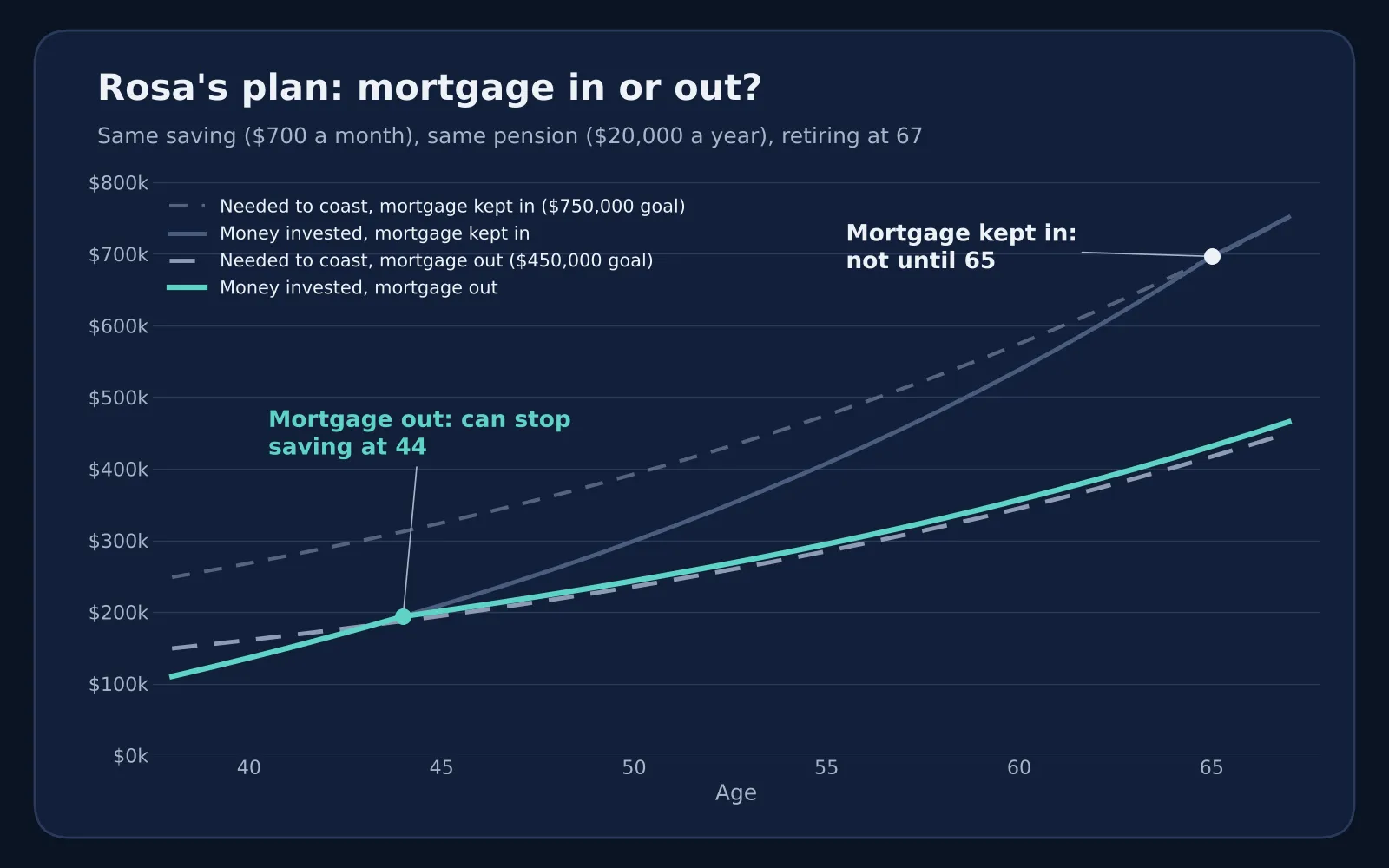
Taking a mortgage she will have paid off out of her retirement spending moves Rosa’s stop-saving age from 65 to 44.

When your home can count: downsizing
Some people plan to sell a family home when they retire and move somewhere smaller or cheaper. The difference can go into your retirement pot. That money can count, as long as you are honest about it.
Say Rosa plans to sell at 67 and buy a smaller place. After moving costs, she expects to free up $80,000. Here is a simple way to put that into the calculator.
The trick: turn the lump sum into yearly income. $80,000 × 0.04 = $3,200 a year. Add that to her pension: $20,000 + $3,200 = $23,200.
Now her pot needed is ($38,000 − $23,200) ÷ 0.04 = $370,000. That is exactly $80,000 less than before, which is the point: the downsizing cash does part of the pot’s job.
Her Coast FIRE number today falls to $122,561. She is 89.8% of the way there and reaches Coast FIRE at 40.
| Rosa’s plan | Pot needed at 67 | Age she can stop saving |
|---|---|---|
| Copies today’s spending (mortgage included) | $750,000 | 65 |
| Mortgage taken out of spending | $450,000 | 44 |
| Mortgage out, plus $80,000 from downsizing | $370,000 | 40 |
| Adds home equity to invested (wrong) | $450,000 | “Today”, but not real |
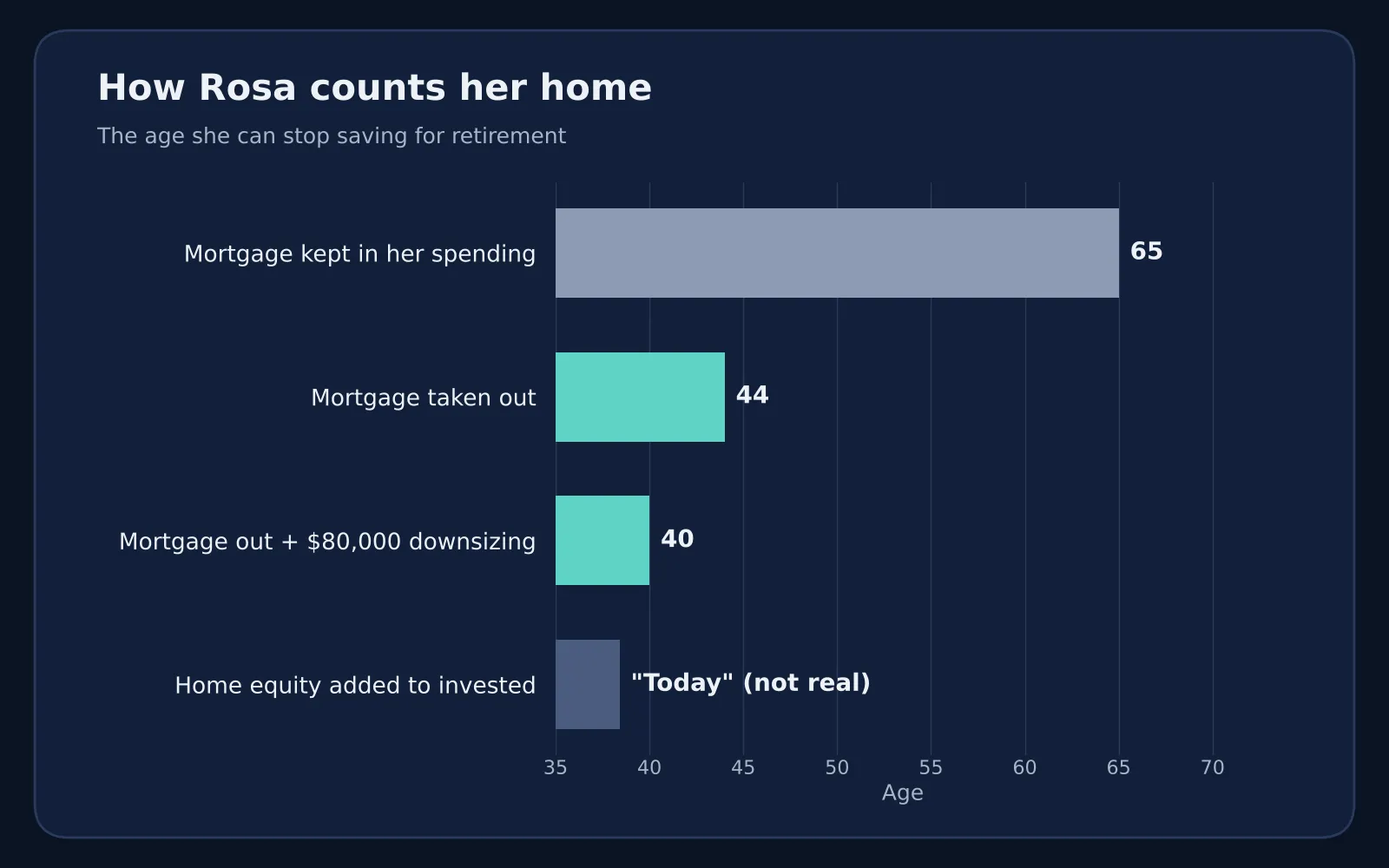
Counting a planned downsize helps a little. Counting the whole house as invested money gives an answer that is not real.
Be careful before you count it
Downsizing gains often shrink in real life. The UK government-backed guide MoneyHelper on downsizing for retirement lists the costs people forget: legal fees and taxes on the move, doing up or adapting the new home, and bills that are not always lower in a smaller place. It also warns that some agents overvalue homes.
A few rules of thumb that keep the plan honest:
- Only count the cash left after the new home and all moving costs, not the sale price.
- Be cautious about the amount. Nobody knows what home prices will do over the next 30 years.
- Only count it if you would really move. Many people plan to downsize and then do not want to leave.
- Run the plan without it too. If you still reach Coast FIRE at a sensible age without the downsizing money, it becomes a bonus rather than a crutch.
What if your mortgage runs past retirement?
If you will still be paying a mortgage for a few years after you retire, you have a choice:
- Keep the payments in your spending. This is the cautious way. The calculator uses the same spending every year, so it plans for the mortgage for life and overstates your number a little.
- Plan to pay it off first. Some people aim to clear the mortgage before they stop working, so the retirement spending figure stays simple.
Either way, the question to ask is: “What will I really pay for housing each year once I stop work?” How to estimate what you will spend in retirement walks through this line by line.
What if you rent?
Renters do not have equity to worry about, but rent does not stop in retirement. Keep it in your spending figure.
If Rosa rented instead, paying $1,300 a month, her retirement spending would be $38,000 + $15,600 = $53,600. Her pot needed would be $840,000, her Coast FIRE number today $278,246, and she would not reach Coast FIRE before 67 saving $700 a month. She would reach about $768,770 at 67.
That is not a reason to buy a home, and renting has real upsides, such as no repair bills and the freedom to move. It just shows why housing is often the biggest single line in a retirement plan.

Your home as a backstop, not the plan
Even if you leave your home out of your numbers, it is still there. Many people see it as a reserve for later life: to pay for care, or to sell if plans change.
Borrowing against your home in retirement is possible in some countries, but it is not free money. The US consumer regulator’s guide, What is a reverse mortgage?, explains that this kind of loan is for homeowners aged 62 and over, that interest and fees are added to what you owe each month, and that you must keep paying property taxes, insurance and upkeep. In the UK, the MoneyHelper page above mentions equity release as one alternative to moving. Rules differ between countries, so if this is ever part of your plan, get regulated advice first.
A home that you leave out of your Coast FIRE number gives you extra safety. That is usually a good thing.
What to do today
Here is how to put your home into the calculator the right way:
- Leave your home’s value out of “invested”. Only count money that can pay you an income: retirement accounts, workplace pension pots and other investments.
- Work out your housing costs in retirement. If your mortgage will be paid off, take it out of your spending. Keep property taxes, insurance and repairs in.
- If you rent, keep the rent in.
- If you plan to downsize, estimate the cash left after all costs, multiply it by your withdrawal rate (0.04 for 4%) and add the result to your pension box.
- Run the plan twice, with and without the downsizing money, and see how far apart the two stop-saving ages are.
- Check again once a year, or when your mortgage, rent or moving plans change.
Home equity and Coast FIRE: questions people ask
Should I include my house in my FIRE number? Not as invested money, unless you plan to sell it and live somewhere cheaper. Include it through your spending instead: a paid-off home means lower yearly costs, which means a lower number.
Does a paid-off house count as Coast FIRE? Not on its own, but it helps a lot. With no mortgage or rent in retirement, you need a much smaller pot. In Rosa’s case, taking the mortgage out lowered her pot from $750,000 to $450,000.
What about a rental property? A property you rent out to others is different, because it pays you an income. One simple way to include it is to add the yearly rent you expect after costs to the pension box. Be cautious, because rent can stop and repairs can be large.
Should I pay off my mortgage early to reach Coast FIRE? That depends on your interest rate, your taxes and how you feel about debt. It is a personal decision, and a later post in this series looks at paying off debt versus investing.
For a couple, the same rules apply: use your household spending, your combined pensions and your combined investments. Coast FIRE for couples shows how. Every setting in the calculator is explained on the methodology page.
Work out your own number
Your home matters to Coast FIRE, but through what you spend, not as money in the bank.
Find your Coast FIRE number. It works for singles and couples, includes pensions, and shows every step of the maths with your own figures. Try your spending with and without your mortgage, and see how much earlier you could stop saving.
This article is for education, not financial advice. All figures are in today’s money and do not include taxes or fees.
What is your Coast FIRE number?
Find the age you can stop saving for retirement. Free, no sign-up, and your numbers stay on your device.
Find your own Coast FIRE numberPhotos: Greta Hoffman, Kindel Media, Greta Hoffman on Unsplash.